
Best Boron Carbide Tiles for Lightweight Armor and Impact Resistance
2026-10-23
When every gram counts and every impact could be the last, armor designers face a brutal truth: steel and alumina can only take you so far. What if the answer wasn't heavier, but impossibly hard, astoundingly light, and shaped to shrug off rifle fire without breaking a sweat? Enter boron carbide tiles—the ceramic that turns “lightweight” from a buzzword into a battlefield advantage. But not all tiles are born equal; subtle differences in density, microstructure, and sintering separate the merely good from the genuinely life-saving. That’s where HUAYI TECH enters the conversation, not just as a supplier, but as a standard-setter in the relentless pursuit of armor that moves with you instead of against you. In this post, we’ll cut through the marketing noise and examine what truly defines the best boron carbide tiles for modern protective systems—and why your current spec sheet might be quietly leaving performance on the table.
Boron Carbide Tiles Aren't Just Hard—Here's What Else Matters
Plenty of buyers fixate on the Vickers number, but hardness alone doesn't tell you how a boron carbide tile will behave when a projectile actually hits it. What sets this material apart is its fracture management. Under high-velocity impact, boron carbide doesn't shatter into large, dangerous chunks like some lower-grade ceramics. Instead, it develops a network of fine microcracks that absorb and dissipate kinetic energy while keeping the backing layer intact. That sacrificial cracking pattern is what makes the difference between stopping a threat and having the plate fail catastrophically behind the strike face.
Weight is another factor that gets overlooked when everyone's comparing hardness specs. Boron carbide has a density roughly 20–30% lower than silicon carbide and alumina, which translates into armor panels that weigh noticeably less for the same protection level. For someone wearing a plate carrier for eight or ten hours a day, that reduction isn't a lab curiosity—it's less fatigue, better mobility, and fewer long-term strain injuries. Add to that its chemical inertness: the material shrugs off acids, alkalis, salt spray, and industrial solvents without corroding, delaminating, or losing structural integrity over time.
Thermal stability rounds out the list of qualities that matter beyond raw hardness. Boron carbide retains most of its mechanical strength at temperatures up to 600°C, while many polymer-backed composites start to soften and lose rigidity well below that point. This makes it a practical choice for vehicle underbellies, aircraft armor, and other high-heat, high-impact environments where the material can't be babied. When you're sourcing tiles, stop asking only how hard they are—ask how they handle the combined stress of impact, corrosion, and temperature swings in the real world.
Why Lightweight Armor Often Turns to Boron Carbide (and When It Doesn't)
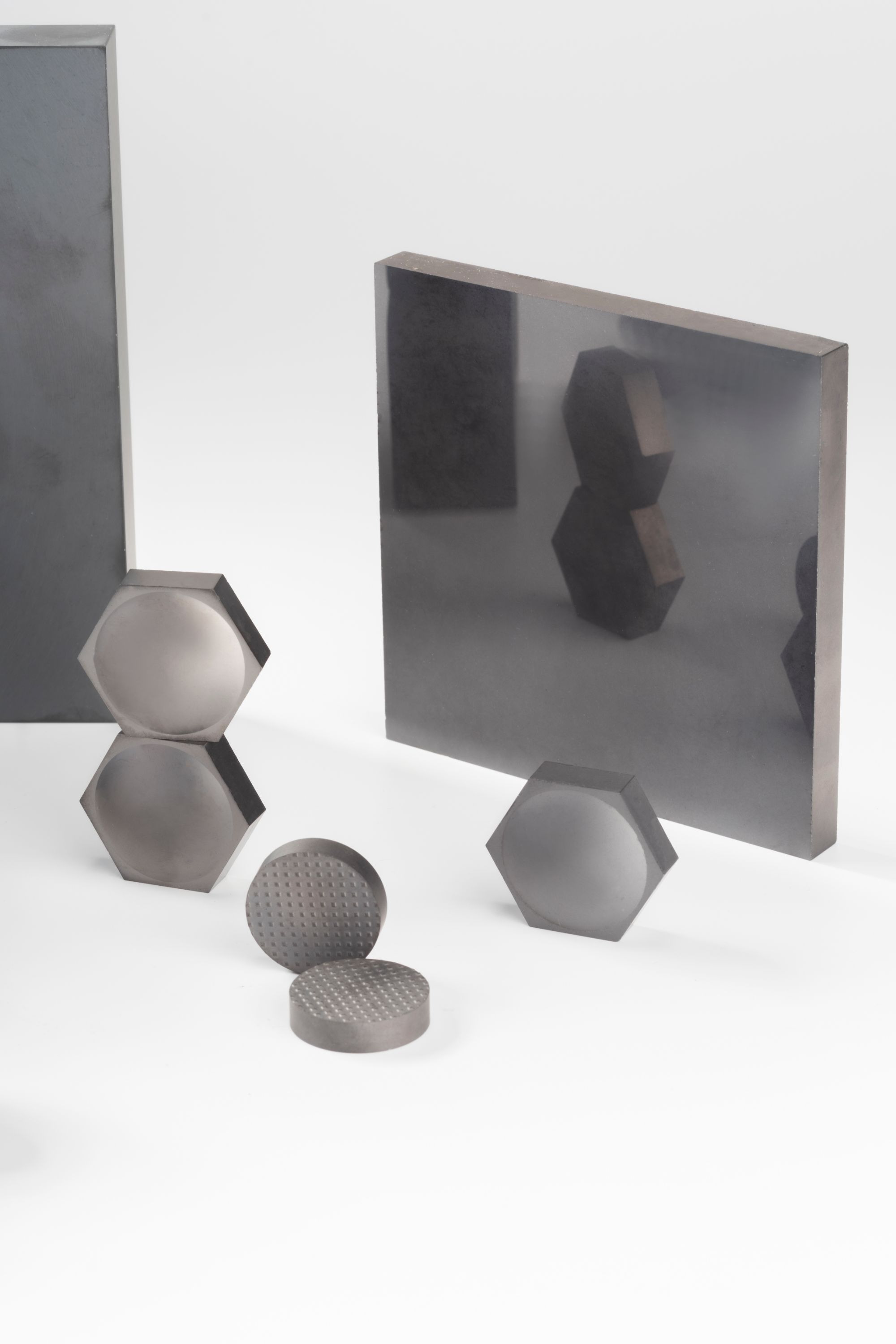
Boron carbide has earned a near-legendary status among armor designers for one simple reason: it stops high-velocity threats while weighing almost nothing compared to steel or even alumina. With a density of just 2.52 g/cm³ and a hardness second only to diamond among engineering ceramics, it offers the best weight-to-protection ratio currently available for personnel and vehicle armor. That combination is why it shows up in everything from helicopter seat inserts to special forces plates.
But that performance comes with real limitations. Boron carbide is extremely brittle and prone to sudden, catastrophic fracture when struck by multiple hits in the same area, which makes it a poor choice for applications expecting repeat impacts or blunt trauma. Its production costs run several times higher than alumina, and machining it is notoriously difficult—typically requiring diamond tooling and long cycle times. This is why budgets, multi-hit requirements, or simpler threat levels often push designers toward silicon carbide or even hardened steel, despite the weight penalty.
The real art lies in knowing when the weight savings justify the cost and fragility. For dismounted soldiers or airborne platforms, every gram matters, and boron carbide is the default choice. For static installations, naval vessels, or armored vehicles that can spare a few extra kilos, cheaper and tougher alternatives win out. Understanding that threshold—where protection per unit mass outweighs the risk of fracture—separates thoughtful armor engineering from blind material worship.
A Practical Look at Boron Carbide vs. Other Ceramic Armor Materials
When you're actually building armor instead of just reading datasheets, the choice between boron carbide and something like alumina or silicon carbide comes down to a messy set of trade-offs. Boron carbide is the lightest of the common ceramic armor materials and also one of the hardest, which makes it the obvious pick for high-end body armor plates where every gram matters. But that lightness and hardness come with a price—literally, and in terms of brittleness. Compared to alumina, boron carbide is significantly more expensive and can shatter more readily under repeated hits, even if its single-shot protection against high-velocity threats is superior. Silicon carbide sits in a middle ground: heavier than boron carbide but tougher and cheaper, so many vehicle armor packages lean on SiC tiles backed by aramid or UHMWPE instead of trying to make B4C work across an entire hull. The practical takeaway is that boron carbide shines where the threat is high and the weight budget is low, but it's rarely the best choice when you need multi-hit capability or cost efficiency.
Another thing that rarely shows up in marketing sheets is how the backing and bonding affect performance. A boron carbide strike face bonded poorly to a polyethylene backer can fail at a lower velocity than a well-bonded alumina tile, simply because the ceramic cracks before the backer can catch the residual energy. In field repairs, alumina is far more forgiving—you can cut and shape it with basic tools, while boron carbide demands diamond tooling and careful handling to avoid microcracks. For prototyping or small-batch armor, many workshops default to alumina or SiC because they can actually work the material without specialized equipment. Boron carbide, on the other hand, is often purchased as pre-formed tiles or small inserts, which limits design flexibility unless you're ordering in volume. That practical constraint explains why so many low-cost ceramic plates on the market are alumina-based, even though boron carbide would technically offer better protection per unit weight.
Going beyond the standard trio, there are hybrid approaches that make sense in specific niches. Some armor manufacturers use a thin boron carbide outer layer over a thicker alumina or SiC core, getting a lighter strike face without paying for a full B4C tile. Others blend boron carbide with silicon carbide in hot-pressed composites to improve toughness while keeping weight below pure alumina. These hybrid systems tend to be more expensive than straight alumina but cheaper than full boron carbide, and they often outperform both in multi-shot tests against armor-piercing rounds. Still, for someone just getting into ceramic armor—whether for personal protection or a light vehicle—there's no substitute for testing samples under realistic conditions. A lab hardness number or a density spec only tells you so much; the real difference shows up when you drop a plate, fire a second round into a cracked area, or try to manufacture a contoured chest plate with a limited tool budget. That's where the practical look separates the materials more honestly than any brochure ever will.
What Field Data Reveals About Boron Carbide Tile Performance
Field reports from armor testing sites and vehicle fleets show that boron carbide tiles often exceed laboratory ballistic limits in single-hit scenarios, but the picture changes once multiple impacts land close together. Cracks propagate further than controlled tests predict, and tiles that pass initial certification can lose significant protective area after the first strike.
Another pattern from deployed units involves edge chipping and delamination. While bench tests focus on center-mass hits, real fragments tend to strike tile corners and seams. These edge failures rarely show up in spec sheets, yet they account for a meaningful share of replacement cycles in the field. Maintenance logs suggest that visual inspection alone misses many microcracks that later widen under vibration and temperature swings.
What surprises many procurement teams is the performance spread between batches. Identical part numbers from the same supplier have shown different backface deformation readings after field use, pointing to variations in sintering temperature or raw powder consistency. Units that track serial numbers and match them to after-action damage reports are starting to build a more useful durability curve than any laboratory datasheet provides.
Red Flags to Watch for When Sourcing Boron Carbide Tiles
A supplier that hesitates or flat-out refuses to share batch-specific test data is usually hiding something. Boron carbide tile performance hinges on consistent density, hardness, and microstructure, and any credible manufacturer should be able to provide third-party verification from a recognized lab. Watch for vague certifications, missing lot numbers, or reports that only list nominal values without actual measured ranges.
Physical inspection often reveals problems before any lab equipment is involved. Look for tiles with visible surface pitting, uneven coloration, or edges that chip too easily under light handling. A quick density check can also be telling: if the measured value dips below 2.45 g/cm³, the material likely has excessive porosity from incomplete sintering or poor powder processing, which in turn compromises both ballistic and wear resistance.
Pricing and lead time anomalies deserve equal scrutiny. Carbide boron raw materials are costly, and proper hot pressing or pressureless sintering takes time, so a quote that undercuts the market by 30% or more while promising identical specs should raise immediate suspicion. Similarly, an unusually short turnaround—say, full production quantities within days instead of weeks—often points to stockpiled rejects, substituted grades, or skipped quality control steps.
Where Boron Carbide Armor Is Heading Next
Boron carbide plates have long been the go-to for stopping rifle threats at minimal weight, but the next wave of work is less about chasing raw hardness and more about surviving multiple impacts without cracking. Researchers are blending in small amounts of silicon carbide or titanium diboride to interrupt crack propagation, while improved pressure-assisted sintering closes the tiny pores that used to act as failure points. The result is a material that keeps its edge after three or four hits instead of one.
Additive manufacturing is starting to change how these components are shaped. Instead of flat tiles that need awkward mounting hardware, producers can print curved chest plates or contoured vehicle panels that fit directly onto the wearer or hull. Some labs are even embedding thin piezoelectric fibers into the boron carbide matrix so that a plate can report when it has been stressed beyond safe limits, turning passive armor into a sensor.
Looking further out, the real shift will be toward layered systems that combine boron carbide's strike face with energy-absorbing backings tuned to specific threat spectra. The goal is not just to stop a projectile but to manage the impulse in a way that reduces blunt trauma. As production costs come down through faster furnaces and recycled powder feedstocks, expect to see these armor packages move from elite military units into police vehicles, civilian aircraft, and even space habitats where micrometeoroid protection matters.
FAQ
Boron carbide offers significantly lower density (around 2.5 g/cm³ vs 3.9 for alumina) while maintaining high hardness, so you get equivalent protection at much less weight. That's critical for body armor or vehicle add-ons where every kilogram matters.
Fine-grained, fully dense tiles handle high-velocity impacts better because cracks don't propagate as easily through grain boundaries. Look for hot-pressed grades with minimal porosity; they tend to survive multiple hits without shattering.
Yes, but it's not a simple process. Manufacturers use precision grinding or net-shape sintering to produce curved plates. The tighter the radius, the more waste and cost, so most designs stick with single-curve profiles rather than complex double curves.
Against 7.62x39mm API or similar, standalone tiles are often 8–10 mm thick. When backed by UHMWPE or aramid, that can drop to 6–7 mm depending on the exact threat level and tile quality.
The ceramic fractures to blunt and erode the projectile, but it needs a ductile backing to catch the fragments and absorb residual energy. A good backing also lets you use a thinner, lighter tile while still meeting the required V50.
Ask for density, hardness (typically 2500–3500 HV), flexural strength, and fracture toughness. Also confirm that the tiles have passed NIJ 0101.06 or similar ballistic certification, not just lab hardness tests. Real-world performance depends on consistent hot-pressing and grinding.
Boron carbide is lighter and harder but usually more expensive and slightly less tough. In some multi-hit scenarios, silicon carbide might tolerate repeated impacts better because it has higher fracture toughness, though boron carbide's weight advantage often wins for personal armor.
Very important. Gaps between tiles create weak zones where a projectile can slip through without engaging the ceramic. Edges should be chamfered or ground flat to prevent stress concentrations that cause premature cracking during transport or minor bumps.
Conclusion
Hardness gets the headlines, but the best boron carbide tiles for lightweight armor earn their reputation through a rare combination of low density, stiffness, and the ability to disrupt high-velocity projectiles before they reach the backing. What separates dependable plates from mediocre ones is usually not the raw material spec but how consistently the tiles are pressed and sintered. Tight grain structure, minimal porosity, and controlled residual stress matter more than a single Vickers number on a datasheet. In practice, boron carbide shines in rigid plates and vehicle add-on kits where every kilogram counts, yet it has real limits in multi-hit scenarios or when uneven back-face deformation pushes the tile past its elastic range. That is why some programs still favor silicon carbide for more ductile failure modes or alumina when cost dominates.
Field data from armor trials and procurement records shows that even small processing flaws—microcracks, density gradients, or oversize pores—turn into early failures after repeated impacts. Buyers who ignore lot-level ballistic testing and only chase quoted hardness often end up replacing panels prematurely. Red flags include unusually cheap boron carbide with no certified density trace, inconsistent thickness across a batch, or vendors who cannot document fracture toughness. On the horizon, pressure-assisted sintering and novel composite interlayers are making tiles tougher without sacrificing the weight advantage. The most credible suppliers are moving toward NIJ-style certification with statistical process control, not just sample coupons. For anyone sourcing today, the best choice is a tile that matches threat level to geometry, tolerates real-world mounting stress, and comes with transparent test data—not just a name that sounds advanced.
Contact Us
Contact Person: Junting Leo
Email: [email protected]
Tel/WhatsApp: +86 18615009766
Website: https://www.huayimaterial-china.com/