

China Stainless Steel Hex Bolts: A Comprehensive Guide for Industrial Buyers
2026-10-08
When sourcing stainless steel hex bolts from China, industrial buyers often face a maze of suppliers, inconsistent quality, and hidden costs. This guide cuts through the noise. Drawing on insights from Wanluo, a trusted name in fastener manufacturing, we explore what really matters—material grades, production standards, and how to partner with the right factory. Whether you're restocking or launching a new project, these practical pointers will save you time and money.
Understanding Stainless Steel Grades Used in Chinese Hex Bolts
When sourcing hex bolts from Chinese suppliers, the grade you pick usually comes down to 304 (often marked A2) or 316 (A4). 304 is the default for general outdoor and mild chemical exposure, while 316 adds molybdenum to handle chlorides and marine environments. Many Chinese mills also produce 201 as a lower-cost option, but it relies on manganese instead of nickel, so corrosion resistance drops noticeably in humid or salty air.
Another grade that shows up in fastener catalogs is 410, a martensitic stainless that can be hardened but offers limited rust protection. It works when you need stronger threads and can accept a light oxide layer, though it will not match 304 in wet conditions. Some hardware suppliers offer 430 as a ferritic alternative, which is fine for indoor use but not advisable for outdoor bolted joints where moisture is present.
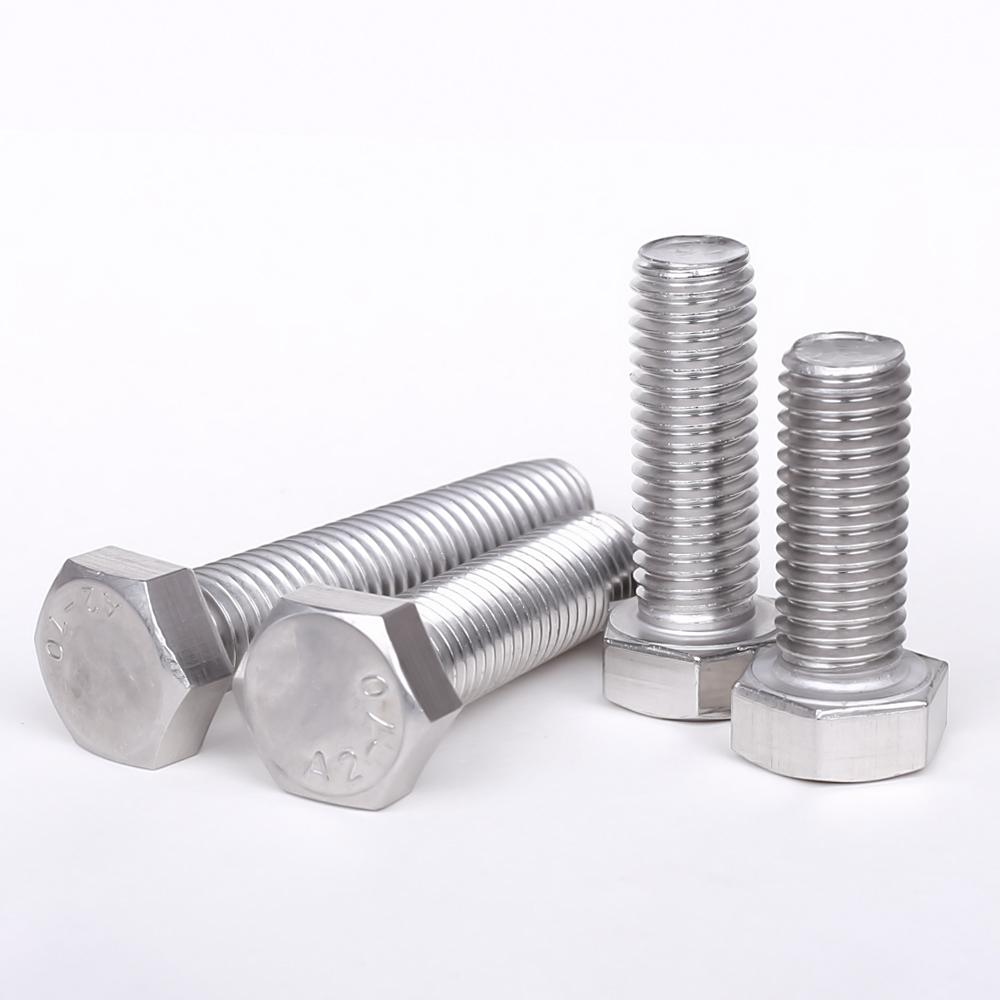
Checking the actual grade is more reliable than relying on color or weight. Look for head markings such as A2-70 or A4-80, and ask for a mill test report if the batch will be used in a critical application. 304 and 316 are usually only weakly magnetic after cold forming, while 410 is strongly magnetic, which can help with a quick spot check when documentation is missing.
Common Manufacturing Standards and Certifications for Chinese Suppliers
Most established Chinese suppliers start with ISO 9001 as a baseline quality management system, but the more capable manufacturers go far beyond that. They pursue certifications that match their specific product lines and target industries—for example, automotive parts makers often hold IATF 16949, while electronics component suppliers may need IEC safety test reports or UL recognition. This selective approach to standards says more about a factory’s real expertise than a generic claim of “meeting international requirements.”
For suppliers exporting to Europe or North America, CE marking is frequently treated as an entry ticket, yet it often relies on self-declaration or limited third-party involvement. Buyers should look deeper: RoHS and REACH compliance matter for materials and chemical restrictions in consumer electronics, toys, and textiles. Reputable factories are usually willing to share SGS or TÜV test reports as independent verification. In the U.S. market, UL listing or ETL certification carries significant weight for electrical safety and is not always interchangeable with Chinese domestic approvals.
Within China, the CCC mark is mandatory for many product categories sold domestically, but export-focused factories may not have it at all—so checking the certificate’s scope and validity is essential. Some leading suppliers are now moving beyond traditional compliance by adopting green factory evaluations, carbon footprint calculations, or even participating in drafting industry group standards. These initiatives don’t replace formal certifications, but they indicate a manufacturer’s commitment to long-term sustainability and technical influence, which can be a more reliable signal than a wall full of outdated certificates.
How to Evaluate Thread Quality and Dimensional Accuracy Before Ordering
Start with the basics: check the thread form under magnification. Look for clean, sharp crests and roots without burrs, tears, or chatter marks. A quick visual pass often reveals surface roughness or plating inconsistencies that will affect assembly later. Run a fingernail along the threads — if it catches, the finish is too coarse for reliable engagement. For coated fasteners, confirm the coating is uniform and doesn't clog the thread valleys, since even a few microns of buildup can shift pitch diameter.
Go beyond the visual and test with thread gauges. A GO ring gauge should spin on smoothly without forcing; a NO-GO gauge must not pass more than two turns. For internal threads, use plug gauges and feel for wobbly or tight spots. Don't rely on a single gauge — check both ends and the middle of the threaded length, as lead errors and taper often show up locally. If you're dealing with high-tolerance parts, ask for a pitch diameter measurement from a calibrated optical comparator or CMM, not just a go/no-go result.
Finally, verify dimensional accuracy beyond the thread itself. Measure the major diameter, shank diameter, and under-head fillet radius if it's a bolt. Compare the actual thread length to the drawing — too short and you lose clamping, too long and you bottom out. For nuts, check the across-flats dimension and bearing face flatness. If the supplier won't provide a first-article inspection report with measured values, treat that as a red flag regardless of how cheap the quote looks.
Corrosion Resistance and Surface Finishes: What Industrial Buyers Should Expect
Industrial buyers often discover the hard way that a shiny exterior tells only half the story. The real measure of a component's lifespan depends on how well its surface holds up against moisture, chemicals, and everyday wear. A finish that looks flawless in a catalog can fail within months if the underlying substrate isn't prepared properly or the coating chemistry doesn't match the operating environment. Smart purchasing decisions start with asking for salt spray test results, coating thickness measurements, and real-world case studies rather than relying on marketing photos.
Surface finishes fall into broad families—anodizing, electroplating, powder coating, passivation, and thermal spraying, to name a few—but the practical differences come down to adhesion, porosity, and edge coverage. A poorly anodized aluminum part may corrode at sharp corners where the oxide layer is thinnest. A zinc-plated fastener that lacks a proper chromate conversion layer will start showing white rust within weeks in humid conditions. Buyers who specify the exact finish standard, such as MIL-DTL-5541 or ISO 9227, reduce the chance of receiving parts that meet only a vague visual description.
Another factor that separates durable finishes from short-lived ones is how the supplier handles defects. Nicks, scratches, and pinholes in a coating create entry points for corrosion that spread underneath the surface. A responsible manufacturer will have a touch-up procedure for cut edges or machined areas, and they will document it in the quality plan. It's worth asking whether the finish was applied before or after final machining, because post-processing often strips protective layers from critical zones. Price alone won't reveal these details—only direct communication with the finishing department or a detailed specification sheet will.
Pricing Factors and Minimum Order Quantities from Chinese Bolt Manufacturers
Raw material costs sit at the heart of any quote from a Chinese bolt factory. Steel wire rod prices fluctuate with global iron ore markets, while alloy additions like chromium or molybdenum push numbers up quickly. A manufacturer might absorb small swings for a loyal buyer, but most pass along sudden spikes within days. Surface treatments—zinc plating, hot-dip galvanizing, or dacromet—add predictable layers, yet the real variable is often scrap rates on complex thread forms. If a bolt demands tight tolerances or special head markings, expect the per-piece price to climb disproportionately.
Minimum order quantities rarely feel arbitrary once you see the production line logic. Cold heading machines churn out thousands of identical pieces per hour, so a 5,000-piece run might barely cover setup time. For standard hex bolts in common sizes, MOQs hover around 10,000 to 50,000 pieces depending on the factory's equipment mix. Smaller specialty shops may accept 1,000 pieces but charge a premium for the privilege. Larger diameter bolts—say M24 and above—often carry higher MOQs because the wire drawing and heat treatment batches need full furnace loads to stay economical.
Don't assume the lowest MOQ means the best deal. A factory that insists on 100,000 pieces for a basic M8 bolt probably runs an older, less flexible line. Conversely, a supplier offering 500 pieces might be repackaging someone else's stock rather than manufacturing in-house. Ask about tooling amortization: some Chinese manufacturers spread the cost of custom dies over the first order, effectively raising unit prices until you hit a second order threshold. Others quote a separate tooling fee upfront, which makes small pilot runs more transparent and often cheaper in the long run.
Shipping, Customs, and Quality Inspection Workflows for Bulk Imports
Coordinating bulk import shipments begins long before a vessel leaves the origin port. Purchase orders are matched against supplier packing lists and commercial invoices, and the logistics team confirms container loading schedules, incoterms, and carrier cut-offs. For high-volume cargo, split shipments and partial container loads require careful tracking so that no consignment arrives without the necessary paperwork or exceeds port free time.
Customs clearance for bulk imports typically involves a multi-step document review: the bill of lading, certificate of origin, harmonized system codes, and any import licenses or permits are cross-checked against the actual cargo description. Errors in declared values, weight discrepancies, or missing certificates can delay release by days, so many importers run pre-clearance checks while the goods are still in transit. Working with a licensed customs broker who understands the product category helps reduce inspection holds and demurrage charges.
Quality inspection is not a single checkpoint but a chain of controls. Pre-shipment inspections at the factory verify quantities, packaging, and product specifications before loading. On arrival, random sampling at the warehouse or third-party lab testing checks for damage, contamination, or non-compliance with the destination market's standards. Any failed lot is quarantined, documented, and either reworked, returned, or scrapped according to the importer's purchase agreement.
FAQ
Focus on material traceability, consistent threading tolerances, and surface finish. Ask for mill certificates and batch test reports rather than relying on generic claims. A supplier who explains their passivation process and packaging standards is usually more dependable.
A2-70 covers general corrosion resistance in mild environments. Step up to A2-80 when higher tensile strength is needed without changing material family. A4-80 adds molybdenum, making it suitable for marine or chemical exposure. Match the grade to the environment, not just the load.
Most established manufacturers produce to DIN 933, ISO 4017, or ANSI/ASME B18.2.1 dimensions. Confirm the specific standard and tolerance class before ordering because mixing metric and imperial specifications can cause assembly problems.
Look for ISO 9001 as a baseline, plus material-specific documentation like EN 10204 3.1 certificates. Some factories also undergo third-party inspections such as SGS or TUV. Certifications alone aren't enough; request samples before committing to volume.
Request spark testing or chemical analysis on random samples. Check that magnetic response and weight align with expected austenitic stainless steel properties. A reputable supplier won't object to independent testing or a pre-shipment inspection.
Overly aggressive price pressure may lead to substitutions in raw material or thinner coatings. Clarify whether quotes include plating, heat treatment, and packaging. Get a detailed specification sheet in writing to prevent later disputes.
Yes, many factories can adjust lengths, thread pitch, or stamp custom logos, but minimum order quantities usually rise. Provide clear drawings and tolerances, and expect to pay for tooling if the profile isn't already available.
Standard sizes may ship within 2-4 weeks if the factory keeps stock. Custom or high-volume orders often take 5-8 weeks depending on production queue and finishing processes. Always confirm the delivery window before issuing a purchase order.
Conclusion
When sourcing stainless steel hex bolts from China, the first thing to understand is the material itself. Grades like 304 and 316 dominate the market, but they behave very differently in chloride-rich or acidic environments. A supplier may quote “stainless steel” without specifying the exact grade, so you need to push for mill certificates and confirm whether the product meets ISO, DIN, or ASTM standards. Many Chinese factories also follow GB standards, which can be equivalent but require careful cross-referencing. Beyond the paperwork, order samples and inspect the thread profile and dimensional tolerances with go/no-go gauges. A slightly undersized thread or poor pitch can cause assembly failures later, even if the bolt looks fine visually. This early verification step separates reliable suppliers from those cutting corners on cold heading or thread rolling.
Corrosion resistance depends not only on the grade but also on the surface finish. Passivation is common, but some buyers opt for zinc plating or black oxide on stainless—though that seems counterintuitive—for specific aesthetic or lubrication needs. Expect to pay more for electropolished or high-polish finishes, especially if the bolts will be visible or used in food-grade equipment. On pricing, Chinese manufacturers often set MOQs based on diameter and length; smaller sizes may require 50,000 pieces, while larger or custom lengths might start at 5,000. Raw nickel and chromium costs move the quote, so lock in prices when possible. Finally, for bulk imports, arrange a pre-shipment inspection with a third party and make sure the supplier understands your customs documentation requirements. Delays at the port usually come from missing certificates or incorrect HS codes, not from the bolts themselves.
Contact Us
Contact Person: Shane
Email: [email protected]
Tel/WhatsApp: 8613357785029
Website: https://www.wanluohardware.com