

Custom Aerosol Cosmetics Supplier Advantages for Distinctive Beauty Lines
2026-11-21
Some of the most recognizable beauty products never announce themselves as aerosols—until you press the actuator and feel the difference. That difference rarely comes from a stock formula. It comes from a supplier who treats propellant, valve geometry, and emulsion stability as one custom system. Wilson works at that intersection, helping beauty brands turn aerosol formats into a sensory signature rather than a packaging afterthought. Here’s why that approach is quietly reshaping distinctive beauty lines.
Custom Bases That Start With Your Formula, Not the Other Way Around
Most base suppliers hand you a fixed starting point and expect the rest of your formula to bend around it. That often means stripping back a fragrance load, swapping a pigment, or accepting texture changes you never wanted. The process feels backwards because it is. When the base is treated as the immovable center, every creative decision becomes a workaround.
A formula-first approach flips that sequence. Instead of asking what a pre-made base can tolerate, the base gets built around the active percentages, pH range, pigment load, and finish you have already locked in. This matters most when a formula is sensitive: changing one solvent or thickener later can unravel stability work done months earlier. Getting the base to match your formula means fewer reformulations and fewer surprises during stability testing.
It also changes the kind of conversations you have during development. You talk about the exact suspension needs, the skin feel at a specific pH, or the way a particular emulsifier interacts with your actives—not about which stock emulsion is closest to what you need. That kind of precision may take a little longer up front, but it tends to save time once production begins.
Aerosol Packaging That Feels Like a Brand Extension
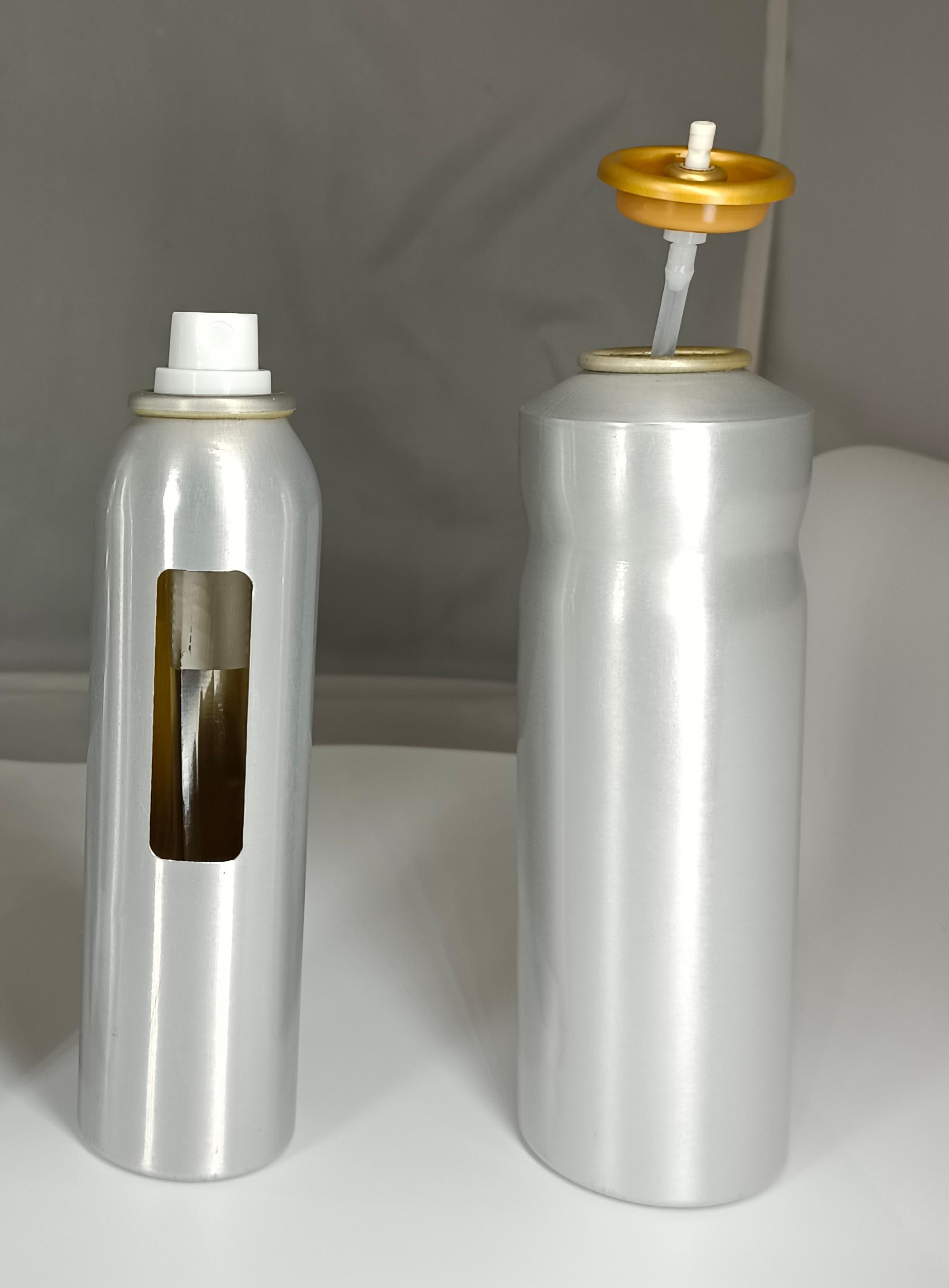
Aerosol cans usually behave like packaging, not like a piece of the product line. They get designed in isolation, with a stock cap and a label that could belong to anything. The moment a can starts borrowing from the same visual system as the primary range—the same proportions, the same tonal shifts, the same odd little details—it becomes something else. It reads as a smaller, pressurized sibling rather than a disposable shell.
That connection often comes from decisions that look minor on a proof. The branding might sit closer to the shoulder, or the label might stop short of the seam so the raw metal becomes part of the layout. When the actuator color matches the cap on a lotion bottle, or the type style carries over without being stretched, the customer doesn't have to study it. They just know it belongs.
A can that works this way doesn't need to mimic the hero product exactly. It needs the right amount of shared vocabulary. The dome, the crimp, the ridge at the base—those industrial features can either fight the design or settle into it. Once they settle, the package stops feeling like a container and starts feeling like a continuation.
Low Minimums Without the Lab-Trial Shortcuts
A low order quantity should not mean your formula gets rushed through the lab. We keep the minimums accessible, but every batch still moves through the same stability screening, preservative challenge testing, and compatibility checks that a much larger run would require. The only thing that scales down is the fill volume, not the due diligence.
That approach changes what you receive at the end: a small run backed by retained samples, real batch documentation, and a formula that has already been stressed before it reaches your customers. It may take a few extra days up front, but it keeps the learning curve out of your launch.
Fragrance and Texture Adjusted to Your Line, Not a Category Average
Most off-the-shelf formulas settle for a middle-of-the-road scent and slip, as if every skin type and product line could be averaged into one safe choice. That's not how we build yours. We adjust the fragrance intensity and the way the product moves across the skin to suit the specific pH, oil balance, and finish of your line—so a gel meant for humid climates feels cool and disappears fast, while a cream for dry, reactive skin stays cushiony without dragging.
That kind of adjustment means no generic “fresh” scent dumped in at the end. A citrus note might be pulled back if your base has natural extracts that already carry brightness; a soft, powdery dry-down might be built up only where it doesn't fight the formula. The result is a texture that feels intentional on contact and a fragrance that reads as part of the product, not something layered on top.
Compliance Work That Happens Before You Think to Ask
Long before a new feature brief lands on a lawyer's desk, someone has already traced where the customer data will live, which subcontractors can touch it, and whether the existing data-processing addendum covers the flow. That scoping rarely announces itself as compliance. It looks like a spreadsheet nobody asked for, a note in a kickoff agenda, or a quiet revision to a vendor checklist. But it is the reason the eventual questions about retention limits or cross-border transfers get answered in hours instead of weeks.
The same pattern shows up in contract review. Standard clauses get adjusted not because a deal is unusual, but because a previous near-miss exposed a gap in audit rights, insurance requirements, or termination assistance. Those edits sit in templates and get inherited by the next negotiation, long before anyone asks whether the company can actually meet them. The work is unglamorous and often invisible, but it continuously narrows the distance between what the business promises and what it can prove.
Much of this early effort lives in systems and habits rather than formal policies. A procurement team flags a data protection questionnaire before it becomes a bottleneck. An engineer's deployment checklist includes a step for region pinning. A sales leader refuses a side letter that would erode a security baseline. None of it waits for a compliance request because the request usually arrives too late to be useful.
Sampling and Scaling Timelines Built Around Real Launch Dates
When a product launch date moves, every downstream sampling and scaling decision tends to ripple in ways that are easy to underestimate. Instead of treating the launch calendar as a rough guide, the timeline itself becomes the backbone: sample readiness checks, pilot cohort sizing, and gradual rollout gates all get locked to specific real dates rather than floating week numbers. That small shift changes how teams talk about risk because a missed date stops being an abstract slippage and starts being a concrete trigger for revisiting which customers enter each phase.
Working backward from an actual launch day also forces earlier clarity on scale ceilings. A team might plan to sample with 200 accounts in early access, then expand to 2,000 once a specific integration is stable. Tying those numbers to calendar milestones makes the ramp feel less like a marketing promise and more like an operational contract. If the launch slips by two weeks, the sampling window does not simply stretch; it compresses the scaling phase, which often means adjusting support capacity, data monitoring thresholds, and the definition of a successful cohort before the next expansion step.
The practical benefit shows up most when real launch dates anchor decisions that would otherwise drift. Instead of asking whether a feature is ready in general, teams ask whether it is ready for the cohort scheduled to onboard next Tuesday. That framing keeps sampling small enough to learn, while making scaling aggressive enough to matter. It also leaves a cleaner audit trail: each expansion point can be traced to a date-driven decision, not a gut feeling or a vague sense that the product felt stable last week.
FAQ
The real edge is in the valve and actuator pairing. A supplier who can adjust flow rate, spray angle, and droplet size gives you a texture that feels like an extension of the product itself, not an afterthought. That matters when your line is built on a signature sensory moment.
Yes, because the canister is sealed and pressurized. Oxygen exposure is minimized during use, so actives like vitamin C or retinol tend to stay more stable compared to open-mouth jars. You may also reduce the preservative load without sacrificing safety.
Look for suppliers that offer modular filling lines or short-run capabilities. Some can handle a few thousand units while still letting you choose custom hardware and propellant systems, so you are not forced into a generic package just to meet a minimum.
Ask whether the supplier can work with compressed air, nitrogen, or bag-on-valve systems alongside traditional propellants. The choice changes the product's pressure, fill feel, and compatibility with clean beauty positioning, so the supplier should explain trade-offs clearly.
They can be. Many modern systems use synthetic or plant-derived gaskets and avoid animal-derived stearates in the valve lubricants. You need to check each component, but a specialized supplier usually has vegan-compatible options ready instead of treating it as a special request.
They should provide guidance on canister pressure ratings, transport testing, label warnings, and regional propellant restrictions. A strong partner will have documentation ready for flammability, volatile organic compound limits, and recyclability claims.
Bag-on-valve separates the formula from the propellant, so the product can be dispensed at any angle and the formula stays purer. It also allows for airless-like preservation in an aerosol format, which gives a premium, high-performance feel that jars and pumps struggle to match.
Experienced suppliers keep a library of stock valves, actuators, and can linings that can be mixed and matched before committing to custom tooling. That means you can refine spray quality and foam density in a few rounds of lab samples rather than waiting months for new components.
Conclusion
A custom aerosol program should start with the formula you already have in development, not a stock base that forces your product idea into someone else's margins. That shift changes everything: the propellant system, the valve, the can lining, and even the spray pattern get tuned around how your formula actually behaves. From there, the packaging decisions stop being a catalog choice and start working like a natural extension of the brand. Liner finishes, actuator shapes, cap details, and fill weights can be matched to the visual language you have already established, so the aerosol does not feel like an outlier in the line. Low minimums matter here, but they should not come from shortcutting stability work. Small runs can still go through disciplined batch records, ingredient verification, and finished product checks before anything reaches a consumer.
Fragrance and texture adjustments are handled as line-specific work rather than a generic category average, which means a dry shampoo, a body mist, or a facial spray can each get the delivery and feel that suit the product's role. Compliance planning is treated as an early step, with documentation, labeling review, and ingredient restrictions raised before they become launch delays. Sampling rounds and scale-up timelines are then built backward from real calendar dates, so the process supports the actual launch rather than asking the launch to wait on the lab. For distinctive beauty lines, the advantage is not just customization in name; it is a supplier rhythm that keeps the formula, package, regulatory file, and production timing moving as one piece.
Contact Us
Contact Person: Simon
Email: [email protected]
Tel/WhatsApp: +86 13267966849
Website: https://www.wilsoncosmetic.com