

Custom Horizontal Machining Center Factory: The Key to Precision Manufacturing for Complex Components
2026-08-28
Precision isn't a luxury when you're machining complex components—it's the entire game. Yet many standard horizontal machining centers fall short when tolerances tighten and part geometries demand multi-sided access without losing rigidity. That's where a custom horizontal machining center factory makes the difference. WINNRUI CNC doesn't just sell machines; they engineer machining solutions around your toughest parts. In the pages ahead, we'll unpack why that factory-level customization matters for repeatable, high-stakes manufacturing.
Why Custom Horizontal Machining Centers Start with the Part
Most machine tool builders begin with a standard frame and then ask how a workpiece might fit into it. That approach quietly limits rigidity, chip flow, and access. When a horizontal machining center is designed around the part itself, the spindle orientation, pallet size, and fixture clearance are dictated by what actually needs to be machined—not by a catalog envelope.
Starting from the part means mapping every critical feature before a single casting is poured. If the component has deep bores on two faces, the machine may need a longer Z stroke or an auxiliary rotary axis rather than a larger table. If chips tend to pile up in a pocket, the coolant delivery and chip conveyor are positioned to pull them away from the cut. These choices are not options on a datasheet; they emerge from studying the workpiece geometry, tolerances, and batch size.
The result is a machine that removes metal more predictably and holds size longer between tool changes. Custom horizontal machining centers built this way often run fewer operations per part because the workholding and tooling were considered together at the start. Instead of adapting the process to a machine, the machine becomes a physical extension of the process plan—which is exactly why the part belongs at the center of the conversation.
The Limits of Standard Machine Shops on Complex Geometries
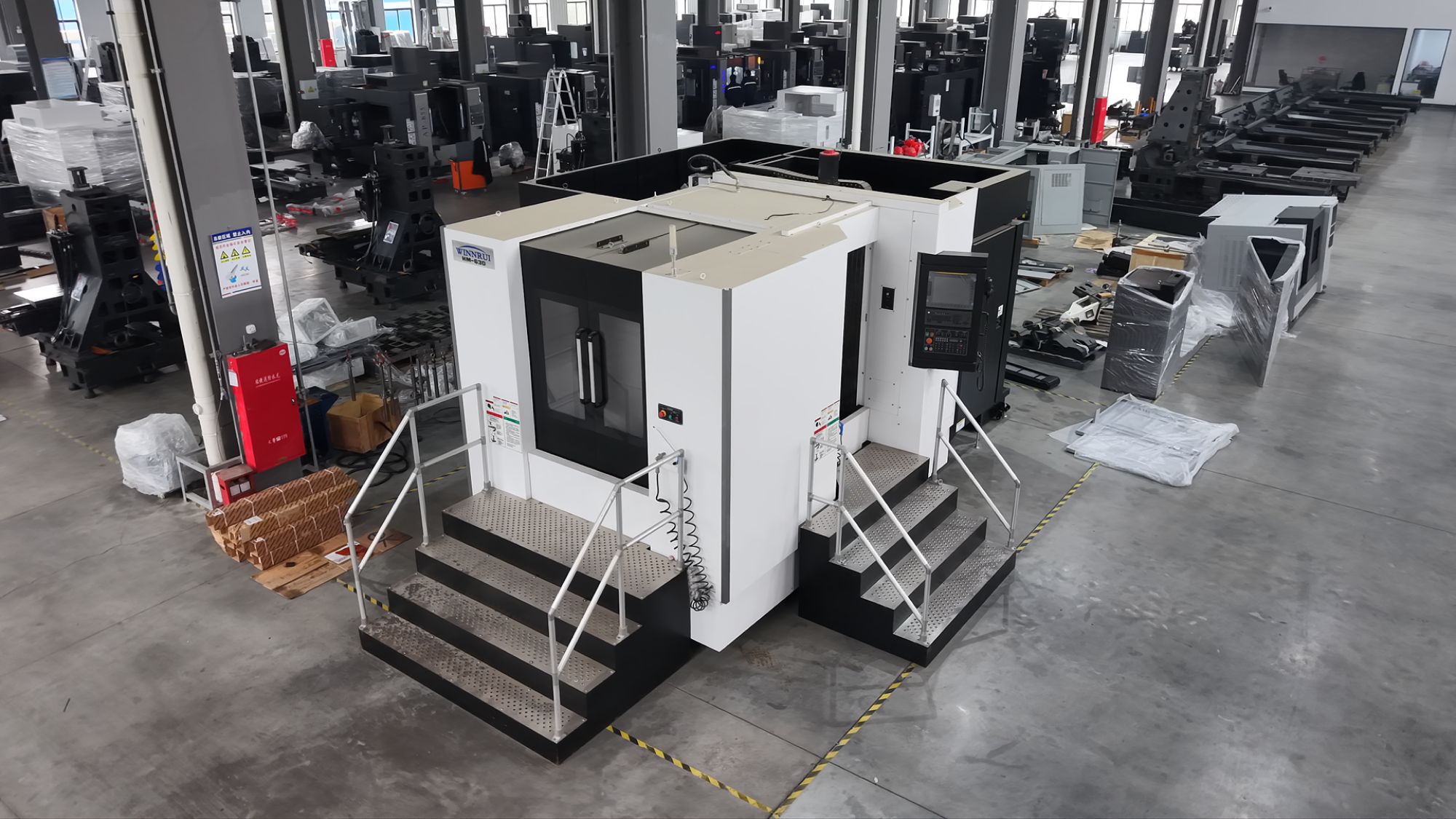
Walk into most job shops and you will see rows of 3-axis vertical machining centers, each capable of squaring up a block, drilling a bolt pattern, or pocketing a flat face without breaking a sweat. But hand one of those machines a part with an internal undercut, a twisted impeller blade, or a thin-walled organic lattice, and the conversation shifts from straightforward programming to a tangle of workholding compromises and toolpath gymnastics. Standard equipment simply lacks the degrees of freedom to reach around corners or tilt into confined cavities, forcing machinists to split a single continuous surface into multiple setups that each introduce stack-up error and the risk of mismatch.
The problem runs deeper than just axis count. Even on a capable 5-axis machine, the default workflow in a typical shop relies on stock CAM templates, standard end mills, and conservative stepovers tuned for prismatic parts. Complex freeform geometry demands variable tool vectors, collision-aware retract moves, and rest machining strategies that leave no scallop behind—skills that rarely make it onto a standard operator’s cheat sheet. As a result, shops either turn away the work, outsource it to a specialty house at a painful markup, or burn hours of trial and error that erode whatever margin the job might have carried.
There is also a quiet ceiling on surface finish and inspection. A conventional shop’s CMM routine was built for flatness, circularity, and hole position—not for sweeping a sculpted surface against a nominal CAD model at hundreds of points per square inch. When the geometry pushes beyond what standard fixturing can hold without deflection, chatter becomes the dominant signature, and the only honest answer is to switch to a different class of machine, a different tooling philosophy, and often a different business model entirely.
Custom Fixturing: The Difference Between a Good Part and a Scrap One
Most shops treat fixturing as an afterthought—clamp it down, indicate it in, and hope the setup survives the cycle. That mindset is exactly where scrap parts come from. A well-designed custom fixture doesn't just hold a workpiece; it anticipates how cutting forces, thermal drift, and vibration will try to move it. Instead of fighting those forces after they show up as chatter or taper, the fixture constrains the part in the right sequence, leaves room for chips to clear, and gives the operator a repeatable way to load without second-guessing every offset.
The difference shows up quickly in tight-tolerance work. A generic vise or toe clamp might grip the part fine on the first run, but by the third part the clamping pressure has shifted a few tenths, or the datum surface gets nicked because the locating point wasn't hardened. Custom fixturing removes that slow drift. It puts the locating features where the print actually references them, not where the stock happens to be convenient. That means the machine can run closer to the nominal dimension without the operator babysitting offsets to chase a moving setup.
Scrap is rarely caused by a bad machine or a bad program. More often, it's the result of a part that moves just enough to be out of spec—or a fixture that takes so long to set up that shortcuts get taken. A purpose-built fixture changes both. It speeds up changeover, reduces clamp-induced distortion, and gives the machinist a solid reference that doesn't rely on feel. When the fixture is designed with the same care as the part itself, the line between a good part and a scrap one stops being a gamble and starts being a process.
Thermal Drift and the Fight for Micron-Level Stability
Any precision system eventually collides with the same stubborn reality: materials expand and contract as temperature shifts, and at micron scales those tiny movements become enormous errors. Thermal drift isn't a single failure mode but a slow, relentless pressure that bends rails, stretches lead screws, and warps the very granite or steel intended to serve as a reference. A machine that holds a perfect position at 20 degrees Celsius can wander several microns by mid-morning, simply because the spindle housing warmed up or a sunlit wall radiated heat into the frame.
Fighting that drift means treating temperature not as an environmental nuisance but as a structural load. Some builders attack it with symmetric design: arranging drives, bearings, and coolant lines so that thermal growth cancels out on opposite sides of the machine. Others rely on active compensation, embedding thermistors deep in the casting and feeding their readings into a model that predicts how much the geometry has shifted. Neither approach eliminates drift completely—they buy back microns one correction at a time, often by accepting that the machine will never be isothermal but can at least be predictable.
The real challenge isn't just holding a number on a display; it's holding that number over hours of thermal cycling, through warm-up transients and uneven cooling. Shops chasing micron-level stability often start their measurements only after a deliberate warm-up routine, or they isolate the entire metrology loop in a temperature-controlled shroud. Even then, a door left open or a cluster of electronics near one leg can undo hours of compensation. Micron-level stability is less about eliminating drift than about making it boring—small, slow, and well understood enough that the control system can quietly cancel it out.
Prototype to Production: Keeping Tolerances Tight at Any Quantity
Moving from a one-off prototype to a full production run usually means watching tolerances drift. The fixtures that held parts perfectly for a handful of units start to flex under volume, tooling wears, and operators make small adjustments that add up. To keep dimensions repeatable regardless of order size, we rely on in-process measurement rather than end-of-line inspection. By checking critical features after each operation, any deviation shows up before it becomes scrap or rework.
A common mistake is assuming that tight tolerances are only a machining problem. Material batch variations, thermal expansion, and even the order of operations can shift results by a few tenths. For high-mix, low-volume work, that means designing fixtures and programs from the start with process capability in mind—not just hitting the nominal on the first article. When the same setup can handle ten pieces or ten thousand, tight tolerances become a byproduct of stable process control rather than heroic effort on each part.
Scaling up doesn't have to mean loosening standards. It does require building feedback loops that work at speed. Automated probing, SPC charts that flag trends before they hit control limits, and tool life management all play a role. The goal is to catch drift early enough to adjust offsets or swap inserts without stopping the line. That way, the thousandth part matches the first one, and the prototype's intent survives contact with production reality.
What to Expect from a Factory Built for Difficult Components
Walking into a facility dedicated to hard-to-make parts, the first thing you notice is the absence of shortcuts. Tooling isn't pulled from a catalog; it's machined in-house, tuned to tolerances that would make a standard shop wince. The floor hums with a mix of older, battle-tested equipment and newer machines retrofitted with custom fixturing. There is no single hero machine—instead, a sequence of deliberately chosen processes, each one compensating for the weaknesses of the last. Operators carry paper notebooks filled with hand-sketched setup notes, and the air smells faintly of cutting oil and ozone.
What sets such a factory apart is not a proprietary coating or a magic alloy, but an obsession with failure modes. Before a single chip is cut, the team walks through every way the part can distort, crack, or drift out of spec during machining, heat treatment, and even shipping. Fixtures are designed with multiple redundant clamping points, and raw material is stress-relieved twice before the first operation. Inspection isn't a final gate; it happens at every handoff, using surface plates, air gauges, and occasionally a coordinate measuring machine so old its software runs on DOS. The goal is not to catch scrap, but to make scrap unthinkable.
Communication runs differently here. Engineers and machinists argue over blueprints in the same room, with actual parts laid on a bench between them. A batch of difficult components might sit for two days while a single dimension is debated and re-verified, because nobody wants to sign off on a guess. Delivery dates are treated as ranges, not promises, and customers are invited to watch first-article runs. The pace feels slow until you realize that every step is removing uncertainty—and that is exactly how hard parts get made repeatedly.
FAQ
Instead of forcing parts to fit a generic machine, the factory configures the spindle, pallet system, tool magazine, and automation around your part geometry and production volume. That might mean a larger work envelope for a bulky housing, a high-torque spindle for tough alloys, or a multi-pallet setup so one part is loaded while another is being cut.
The horizontal spindle orientation lets chips fall away by gravity, so you don't get recutting that damages surface finish or throws off dimensions. Combined with a built-in rotary pallet, it can reach multiple faces of a part in one setup, which cuts down on stack-up errors and keeps tight tolerances more repeatable from the first piece to the last.
Aerospace, automotive powertrain, hydraulics, medical device manufacturing, and heavy equipment. They share a common thread: parts with deep bores, angled faces, or tight geometric tolerances that would require too many setups on a vertical machine.
The factory can match the spindle nose, bearing arrangement, and thermal compensation to the exact cutting conditions. If you're boring a deep gearbox housing, they might spec a longer quill and through-tool coolant to control chip evacuation and heat. Those choices keep the tool on center and reduce drift during long cycles.
Look for a team that starts with a process review, not a sales pitch. Ask how they handle thermal growth, fixture rigidity, and tool wear monitoring. A good factory will also show you sample parts with inspection reports, not just machine specs.
Yes, if the factory designs the automation around your mix. A pallet pool with quick-change fixtures lets you run a family of parts on the same cell. For high volume, they might add a robot or gantry loader and a larger tool magazine to keep spindle utilization high without sacrificing changeover speed.
It depends on your part mix. If you're fighting tolerance stack-up from multiple clampings or losing hours to manual chip clearing in deep pockets, the horizontal configuration can remove those bottlenecks. The factory should be able to estimate cycle time and scrap reduction from your current process data before you commit.
Conclusion
A custom horizontal machining center factory approaches every job from the geometry of the part itself, not from a library of pre-set machine parameters. Standard shops often struggle when a component has deep bores, angled faces, or intersecting pockets because their fixtures and toolpaths are built around generic setups. The difference shows up in how the workholding is designed: a custom fixture might brace the part at six points instead of three, or use hydraulic clamping sequenced to avoid distortion. Without that, even a good machine will produce scrap on the second or third operation. This part-first mentality also dictates spindle speed, coolant pressure, and chip evacuation—details that get overlooked when a shop tries to force a complex part into a standard horizontal cell.
Thermal growth is another place where a dedicated factory separates itself. Long cycles and heavy roughing heat up castings, columns, and ballscrews, shifting the tool tip by microns. The best custom facilities monitor spindle housing temperature and machine base temperature, then compensate in real time or run warm-up routines before critical features are cut. That level of control carries from one-off prototypes to runs of five hundred, because the same fixture concepts and thermal maps are reused. When you work with a factory built for difficult components, you should expect process capability studies, in-process probing at multiple stages, and a documented tolerance stack-up before the first chip is cut. The result is not just a machined part but a repeatable process that holds tenths across production, not just on a single sample.
Contact Us
Contact Person: Tim
Email: [email protected]
Tel/WhatsApp: +86 15522553731
Website: https://www.winnrui-cnc.com/