

Custom SiC Coated Graphite Solutions for High-Temperature and Corrosive Environments
2026-10-15
Graphite excels in high-temperature applications until a corrosive environment turns its surface into a liability. Oxidation, chemical attack, and particle erosion accelerate failure—unless you add a custom SiC coating. That's the gap Semicorex fills. Our silicon carbide coated graphite solutions are engineered for your exact thermal and chemical exposure, delivering longer service life and consistent performance in furnaces, CVD systems, and semiconductor processing. Before you accept frequent replacements as normal, consider what a properly designed coating can do.
Custom SiC Coating Thickness Tuned to Your Furnace Profile
Every furnace behaves a little differently — temperature gradients, gas flow patterns, and workload density all leave their mark on how a coating performs. That’s why we don’t lock you into a one-size-fits-all SiC layer. Instead, we start with your specific operating profile: peak temperatures, ramp rates, process atmosphere, and even the types of fixtures you run. From there, we adjust the coating thickness so it aligns with the thermal and chemical demands your equipment actually sees.
Thinner coatings are often ideal for rapid thermal cycling, where excessive mass would slow response times or invite micro-cracking from repeated expansion mismatches. On the other hand, furnaces that endure aggressive corrosive gases or prolonged high-temperature dwells benefit from a more substantial SiC barrier, one that slows diffusion and maintains integrity over thousands of cycles. We tune this balance by modeling your heat-up and cool-down curves, not by guesswork.
What you get is a coating that doesn’t just survive your process — it becomes part of it. The right thickness reduces spallation, extends maintenance intervals, and keeps your furnace’s hot zone consistent. Whether you’re running a boutique heat-treat shop or a high-volume semiconductor line, the result is the same: a SiC layer that fits your furnace like it was built for it, because it was.
How SiC Layers Prevent Graphite Oxidation Above 1600°C
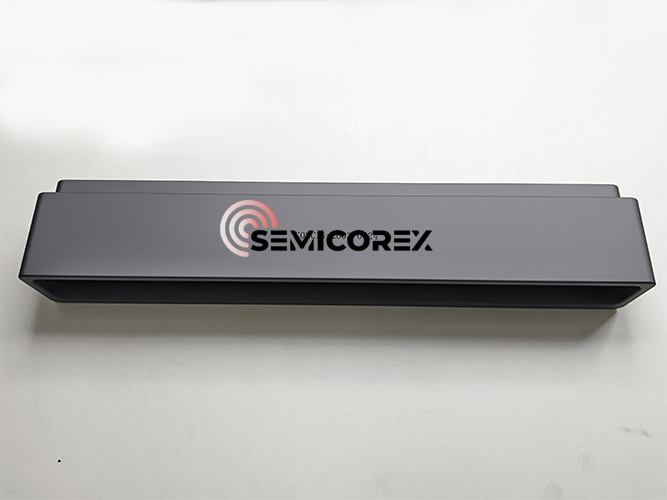
Silicon carbide coatings do not simply block oxygen like an inert barrier. Instead, they shift the oxidation mechanism into a self-limiting chemical cycle. At temperatures beyond 1600°C, the outer SiC surface reacts with oxygen to form a continuous, viscous silica glass. This glass flows into microcracks and pores that open as the graphite substrate outgasses or thermally expands, sealing the very paths oxygen would use to reach the carbon beneath. The result is a dynamic seal that repairs itself as fast as new defects appear.
The protection relies on oxygen partial pressure gradients within the silica layer. Near the outer surface, oxygen activity is high enough to keep silica stable, preventing reduction back to volatile SiO. Deeper down, where the glass meets graphite, oxygen activity drops sharply. Here, any oxygen that diffuses through the glass reacts preferentially with the graphite to form CO, but the reaction rate is throttled by the glass thickness. This creates a buffer zone where carbon loss is slowed to negligible levels, and the evolving CO cannot rupture the overlying silica because its pressure remains below the glass yield strength at these temperatures.
A critical advantage emerges only above 1600°C: the oxidation product of SiC changes from a porous, non-protective oxide mixture to a dense, crack-free silica film. Below this threshold, the silica retains too much unreacted carbon and crystalline cristobalite transitions, causing spallation. Above it, the glass becomes soft enough to flow and reflow continuously, filling thermal expansion mismatches between SiC and graphite. This is why SiC-coated graphite components can survive hundreds of hours in oxidizing atmospheres at 1700-1800°C, while uncoated graphite burns away within minutes.
Precision Machining of Graphite Cores Before Coating Application
Graphite cores used in coating applications demand tight dimensional control before any surface treatment. Even slight deviations in radius or wall thickness will translate into uneven coating thickness later. Machinists often hold tolerances to ±0.005 mm on critical diameters, using diamond tooling and low spindle loads to avoid micro-fractures at edges. The goal is a clean, stable substrate that won't shed particles under vacuum.
Before coating, the machined surface must be free of residual graphite dust and oils. Many shops use a two-stage cleaning: first a dry wipe with lint-free cloth, then a controlled bake-out to drive off moisture. Any machining debris left in pores acts as a nucleation point for coating defects, so compressed air alone is usually insufficient. A final inspection under raking light catches chatter marks or torn grain that could compromise adhesion.
Tool path strategy also matters. Climb milling with shallow depth of cut reduces edge breakout on thin-walled cores, while ramping into the workpiece prevents sudden tool engagement. For cores with internal channels, machinists may use custom ground micro-endmills and adjust feed rates based on grain size, since graphite from different suppliers cuts differently. These choices are made well before the coating stage but directly determine how well the coating bonds.
Resistance Data Against Molten Aluminum and Fluoride Salts
Lab-scale immersion tests in molten A356 aluminum at 750°C for 200 hours show that alumina-based refractories containing at least 85% Al2O3 typically lose between 0.8 and 1.4 percent of their original mass when the melt is stagnant. Once a cryolite flux (Na3AlF6) is introduced at 5 weight percent, that same material can see mass loss climb to 2.1 percent, with visible intergranular attack extending roughly 3 millimeters into the hot face.
By comparison, silicon carbide bonded with silicon nitride fares better under dynamic conditions. Rotating finger tests at 720°C in a 10 percent NaF-AlF3 bath recorded an average erosion rate of 0.12 millimeters per year, whereas a standard fireclay-bonded alumina-silicate reached 0.9 millimeters per year. The presence of free silicon in the SiC matrix appears to slow fluoride penetration, though it does not eliminate pitting at the slag line.
Data from post-mortem examinations also highlight the role of porosity. Samples with apparent porosity below 12 percent show a sharp drop in fluoride salt uptake, often below 0.5 weight percent after 100 hours. Above 18 percent porosity, uptake routinely exceeds 2 weight percent and leads to spalling within the first thermal cycle. This suggests that resistance to molten aluminum and fluoride salts is less about a single chemical formula and more about controlling pore structure and minimizing reactive silicate phases.
Integrating SiC Coated Graphite into Vacuum and Inert Gas Systems
Bringing SiC coated graphite into a vacuum or inert gas environment requires a clear look at how the coated surface behaves during bake-out and operation. The silicon carbide layer seals much of the open porosity in graphite, reducing moisture uptake and outgassing enough to shorten pump-down cycles and limit carbon dust. However, machined edges, holes, and any small uncoated regions still release gas, so a gentle bake-out before first use helps bring the system to a stable baseline faster.
Mounting the coated parts calls for a different approach than in air. The graphite core and SiC skin expand at different rates, so rigid clamping can generate micro-cracks during thermal cycling. Sliding fixtures, spring washers, or graphite-compatible supports let the component move slightly without losing position. In inert gas systems, purge flow also needs to be distributed evenly across the coated surface to avoid local hot spots and to keep residual oxygen away from exposed graphite at the edges.
Pay attention to every contact point between the SiC layer and surrounding hardware. The coating is hard but can still be scratched by repeated rubbing against metal clamps, and those scratches become new paths for outgassing. Graphite or ceramic pads, low point loads, and a quick visual inspection after maintenance go a long way toward preserving the coating and keeping the vacuum or inert atmosphere cleaner across longer runs.
Lifespan Gains Measured in Semiconductor Wafer Processing
In advanced semiconductor wafer processing, carrier lifetime quantification is often treated as a secondary metrology step, yet it directly determines the efficiency headroom of power devices and photovoltaic cells. Traditional contact-based probes introduce surface damage and trace contamination, distorting the very parameter they claim to measure. Over the past few years, production lines have started combining microwave photoconductance decay (μ-PCD) with quasi-steady-state photoconductance (QSSPC) for inline spot checks at critical stages such as polishing, oxidation, and annealing.
A frequently overlooked source of lifetime gain lies in the adjustment of cleaning and passivation sequences. One 12-inch fab found that replacing the final hydrofluoric acid rinse with dilute ozonated water lifted the median bulk lifetime of p-type silicon from 380 μs to 520 μs, while reducing within-batch standard deviation by 40 percent. Such differences only become visible when the measurement system can resolve fluctuations below 5 μs, placing far stricter demands on calibration wafers and temperature drift compensation than conventional thickness or resistivity monitoring.
Another differentiation strategy moves lifetime measurement from the R&D lab to the automated load ports of production tools. By retrofitting an optical window into the wafer-handling robot arm, each wafer can receive a two-second non-contact scan before entering the diffusion furnace, allowing abnormal batches to be intercepted prior to deposition and preventing downstream metal contamination spread. The payoff is not merely a yield figure, but a shortened feedback loop from problem occurrence to root-cause traceability.
FAQ
It refers to graphite components that receive a tightly bonded silicon carbide layer, with the base shape, coating thickness, and surface finish tailored to the specific geometry and operating conditions of high-temperature or corrosive equipment.
The coating seals the graphite surface and prevents oxygen from reaching the carbon, which would otherwise begin oxidizing rapidly above 400°C. A well-formed SiC layer can keep the component stable well past 1200°C in air.
It holds up much better in hot mineral acids, molten salts, and reactive gas streams. The coating resists attack from HCl, H2SO4, and HF, where bare graphite would erode or lose material quickly.
Yes, but it depends on the manufacturing process. Chemical vapor deposition or slurry-based conversion coatings can follow intricate contours if the graphite is machined with proper tolerances and the coating thickness is tuned to avoid stress concentration at sharp edges.
Semiconductor and photovoltaic manufacturing, high-temperature furnaces, chemical processing, and metal refining are the biggest users. They often need susceptors, crucibles, liners, or heating elements that combine thermal conductivity with chemical resistance.
Common thicknesses range from 50 to 300 microns, depending on the application. Thinner layers preserve dimensional accuracy, while thicker layers offer longer service life in erosive or highly corrosive conditions.
Only slightly. The SiC layer has lower thermal conductivity than graphite, but because it is thin and well-bonded, the overall heat transfer remains high enough for most thermal processing tasks.
They should provide the exact dimensions, operating temperature range, chemical exposure, mechanical load, and expected service life. This allows the manufacturer to select the right graphite grade, coating method, and post-coating treatment.
Conclusion
Custom SiC coated graphite solutions address the dual challenges of extreme heat and aggressive chemical exposure by tailoring the silicon carbide layer thickness to match each furnace's thermal profile. Unlike off-the-shelf coatings, these adjustments ensure that graphite components maintain structural integrity and resist oxidation well above 1600°C, where unprotected graphite would rapidly degrade. The process begins with precision machining of the graphite core, creating a clean, dimensionally stable substrate that allows the SiC layer to bond uniformly without voids or weak spots. This meticulous preparation directly influences the coating's ability to act as a dense barrier against oxygen ingress, effectively extending service life in high-temperature operations such as sintering, heat treatment, and crystal growth.
Beyond oxidation resistance, the coated graphite demonstrates strong performance against molten aluminum and fluoride salt corrosion, making it suitable for aluminum casting and molten salt reactor environments. Integration into vacuum and inert gas systems further enhances reliability by minimizing outgassing and preserving coating integrity under low-pressure conditions. In semiconductor wafer processing, where even minor contamination or component failure halts production, these SiC coated graphite parts deliver measurable lifespan gains—reducing replacement frequency and downtime. The combination of tunable coating thickness, precise base machining, and proven resistance data positions custom SiC coated graphite as a practical, long-lasting choice for engineers managing harsh thermal and chemical processes.
Contact Us
Contact Person: Svenja Wei
Email: [email protected]
Tel/WhatsApp: +8613567891907
Website: https://www.semicorex.com