

Elderly Mobility Wheelchair Production for Safer Independent Living
2026-09-02
Ask anyone who uses a standard wheelchair at home, and you’ll hear the same list of fears: tipping on a rug, reaching a high shelf, getting stuck in a hallway. Most chairs simply weren’t made for real rooms. That’s the gap Freedomchair targets in its production process. Instead of adapting hospital designs, the team starts with everyday independence risks and builds outward—from frame geometry to brake placement to battery redundancy. The result is a chair that feels less like medical equipment and more like a tool for living safely on your own terms. In the sections ahead, we’ll break down what goes into that production and how each decision supports safer independent living.
Factory Decisions That Quietly Shape Wheelchair Safety
When a wheelchair frame comes off the welding line, the choice between MIG and TIG welding isn't just a production detail—it determines whether the joints will crack after two years of curb drops or hold up through a decade of daily transfers. Many factories default to faster, cheaper methods, but those micro-decisions about heat input and filler material quietly show up in the form of fatigue fractures.
Another overlooked area is the tolerance stack between the caster housing and the fork stem. If the factory lets that clearance drift by even half a millimeter, the chair develops a shimmy at speed that users feel as instability, yet it rarely gets traced back to the assembly drawing. Tightening those tolerances, or adding a simple jig to check alignment, costs almost nothing but changes whether a chair tracks straight on a crowned sidewalk.
Even the choice of upholstery adhesive matters more than it seems. A solvent-based adhesive might speed up drying times and cut labor costs, but it can break down the foam and release fumes that degrade the seating surface within months. Factories that switch to water-based adhesives aren't just being eco-friendly—they're preventing the slow sag that forces users into asymmetric postures and pressure sores.
The Real Reason Some Wheelchairs Feel Stable on a Slope
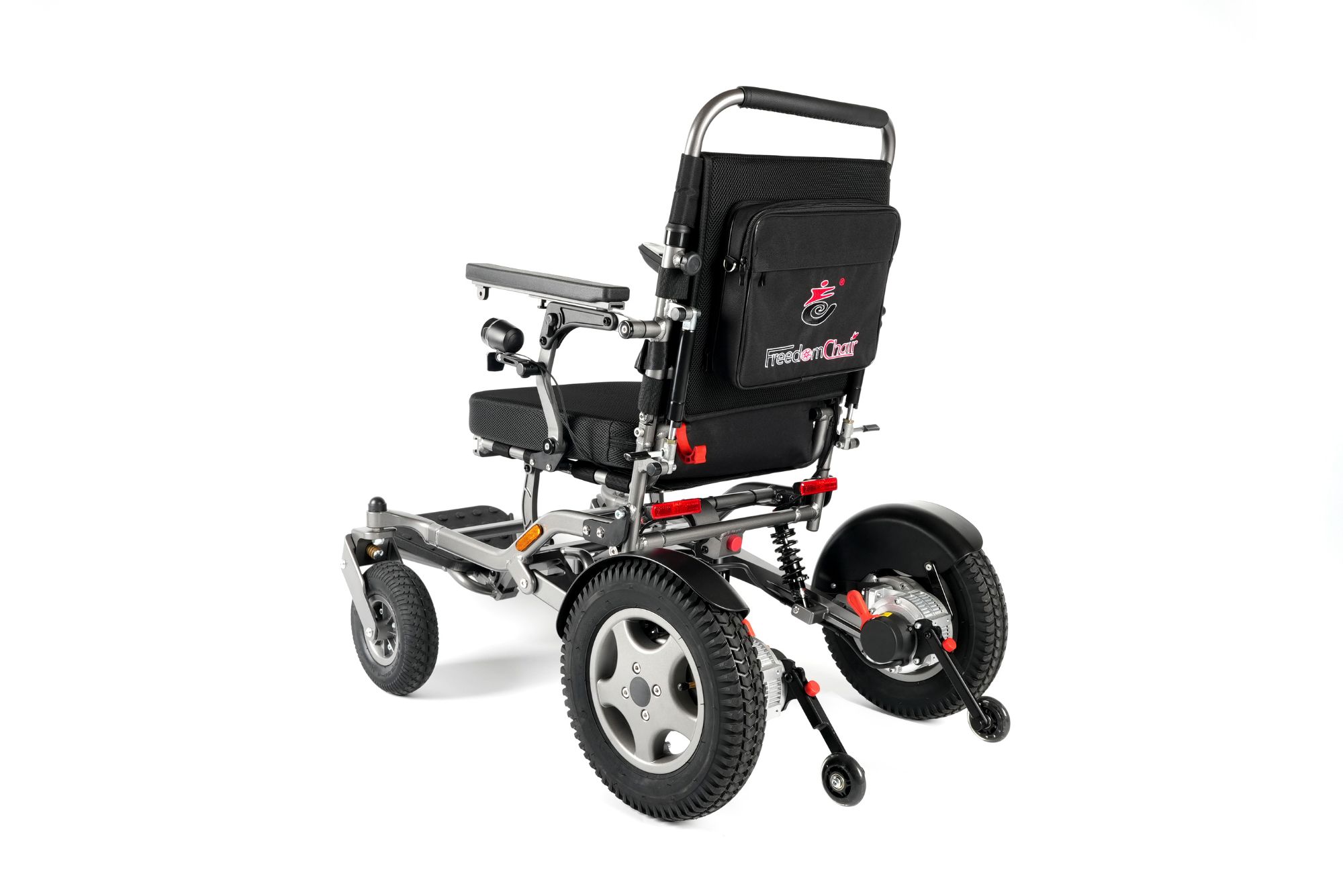
A wheelchair's stability on an incline isn't just about wheel size or frame weight—it's primarily a matter of where the center of gravity sits relative to the rear axle. When the user's combined weight with the chair is positioned slightly behind the axle, the front casters naturally want to lift on a slope, which can feel unstable. But when that center of gravity is tuned to sit just ahead of the axle, gravity pulls the chair back into the rear wheels, keeping the casters grounded and the rider feeling secure.
Many active wheelchair users adjust their rear axle position forward or backward to fine-tune this balance. Moving the axle rearward makes the chair more resistant to tipping backward, but it also increases the effort needed to push and can make the front end feel heavy. Moving it forward creates a more responsive, agile chair that rolls easily over uneven ground, but it reduces the margin of safety on steep slopes. That trade-off is why two chairs with identical wheels can feel completely different on the same ramp.
The real secret isn't a special tire tread or a wider base—it's the dynamic relationship between the seat angle, axle placement, and the user's own posture. A slight forward lean shifts weight onto the front of the seat, lowering the effective center of gravity and making the chair track straighter downhill. Conversely, leaning back or adding a heavy backpack behind the backrest can make a previously stable chair feel tippy. Understanding this lets riders make small, deliberate adjustments that transform how their wheelchair behaves on any slope.
Why a Wheelchair Isn't Just a Chair With Wheels
A wheelchair looks simple at first glance—a seat, a couple of wheels, maybe some push rims. But that impression falls apart the moment you sit in one for a full day. The angle of the backrest, the height of the footplates, the width of the seat, even the type of caster on the front: every detail changes how your body feels after hours of use. A regular chair supports you while you're still. A wheelchair has to support you while you move, twist, reach, and transfer, all without causing pressure sores or throwing your spine out of alignment.
Then there's the way a wheelchair becomes part of your body. You don't just sit in it—you steer with subtle shifts of weight, feel the texture of the ground through the frame, and learn exactly how much momentum you need to clear a doorway or roll over a cracked sidewalk. That's not furniture. That's a mobility device with its own physics, its own maintenance needs, and its own relationship to your daily life. A chair with wheels holds you in place. A wheelchair lets you participate in the world.
What really sets a wheelchair apart is the customization. No two users have the same needs, and the best chairs are measured to the centimeter, adjusted for posture, strength, and lifestyle. A poorly fitted chair drains your energy and can cause long-term injury. A well-fitted one becomes an extension of your intentions—not just a place to sit, but a tool for independence. That's why calling it a chair with wheels misses the point entirely.
How Production Tolerances Prevent Pressure Sores and Falls
The quiet work of production tolerances rarely gets attention, yet it sits behind two of the most stubborn safety problems in care settings. A tolerance of half a millimeter in a foam cutting line or a mismatched bracket can be the difference between an even support surface and a localized pressure peak. When manufacturers hold critical dimensions within tight limits, they remove the small irregularities that eventually translate into skin breakdown or a caught wheel.
For pressure sores, the mechanism is straightforward. A mattress or cushion that meets flatness and density tolerances spreads load across the largest possible area. Any deviation—a seam that rises a few millimeters, a foam batch that cures slightly firmer than specified, a cover that bunches instead of lying flat—creates a point where capillary pressure rises enough to starve tissue. Tight production tolerances on layer thickness, adhesive application, and cover stretch keep those deviations out of the finished product. That is why an operator checking a digital caliper against a foam blank is not just doing quality control; they are preventing an ulcer that might take months to heal.
The same logic applies to falls. Wheelchair frames assembled within specified tolerances keep all four wheels on the floor and the caster stems vertical, so the chair does not shimmy or tip when a user shifts weight. Bed rails and floor mats that fit flush, with gaps controlled to the millimeter, remove the edges that catch slippers or walking aids. Even a small misalignment in a brake linkage can leave a chair rolling during a transfer. By refusing to let parts drift beyond their allowed range, production tolerances turn a correctly designed product into a reliably safe one.
Materials That Survive Daily Life Without Adding Bulk
A jacket made from high-tenacity nylon ripstop can shrug off years of strap friction and sharp edges while folding down to almost nothing. The trick isn’t thicker yarns; it’s a tight weave with a reinforced grid that stops tears before they spread. Similar logic applies to Dyneema and other ultra-high-molecular-weight polyethylenes, which offer the cut resistance of heavier fabrics at a fraction of the weight.
On hard goods, thin-wall titanium and precision-machined aluminum keep structural strength without the heft of steel. These alloys handle daily drops, key scratches, and temperature swings while staying slim enough for pockets and bags. Even small choices, like moving from plastic buckles to stamped metal or from foam padding to EVA with strategic cutouts, remove bulk without sacrificing durability.
The real difference comes from lamination and bonding rather than added layers. A single sheet of reinforced TPU can replace multiple fabric panels, cutting seams and weak points. When materials are chosen for how they distribute stress instead of how much mass they add, everyday gear lasts longer and carries lighter.
Independent Living Starts With a Fit That Ignores the Average
A chair that works for someone six feet tall can be a daily obstacle for a person a foot shorter — and the same holds true for almost every tool meant to support independence. When designs chase statistical norms, they quietly exclude the people whose bodies, strength, or habits fall outside that middle range. Real autonomy starts when measurements are taken from the individual, not from a population chart.
Ignore the average and you start noticing details that matter: the height of a counter, the resistance of a door handle, the angle of a ramp. Each small mismatch adds friction, while a precise fit removes it. The goal isn't to accommodate most people — it's to give one person the confidence to move through a room without second-guessing every reach or step.
That kind of fit often comes from observation and conversation rather than standardized sizing. A physical therapist watches how someone transfers from bed to chair. A carpenter adjusts a grab bar two inches lower. These are not luxury tweaks; they are the difference between a space that simply meets code and a space that actually returns control to the person living in it.
FAQ
It usually comes down to stability, easy-to-use controls, and a seat that prevents pressure sores during long periods of sitting. A lower base and anti-tip wheels also help prevent falls when reaching or transferring.
Manufacturers run each frame through fatigue testing that simulates years of bumps and uneven surfaces. Brakes are checked under load, and casters are selected to resist wobbling at slow indoor speeds.
Aluminum or titanium frames are popular because they stay light enough to push but don't crack under repeated stress. Upholstery is often breathable nylon with sealed seams to reduce moisture buildup and skin irritation.
Yes, many models allow the seat depth, backrest angle, and armrest height to be changed without special tools. Some also let you swap in larger rear wheels later if upper body strength declines.
Wheel locks need to hold the chair firmly on ramps and during transfers in and out of bed. Drum brakes or attendant brakes give extra control when a caregiver helps on slopes.
Prototypes are pushed through standardized obstacle courses that include door thresholds, carpet edges, and cracked pavement. The goal is to confirm the chair doesn't tip forward when the front casters hit a small lip.
Flip-back or removable armrests and swing-away footrests create a clear path to stand up or slide to a bed. Some designs also add a seat belt that can be released with one hand.
They often use double-wall tubing at high-stress joints while keeping the overall frame under 30 pounds. That way the chair can be folded and lifted into a car trunk without sacrificing long-term strength.
Conclusion
The safety of an elderly mobility wheelchair begins long before a user takes it home. Factory decisions about frame geometry, weld quality, and component alignment quietly determine whether the chair will hold steady on a ramp or wobble at a curb. A wheelchair is not simply a chair with wheels; its center of gravity, wheelbase, and axle placement are tuned so that a gentle slope does not turn into a tipping hazard. Production tolerances matter in ways most people never see. When seat pan angles and backrest curves are held to fractions of a millimeter, pressure points are distributed more evenly, reducing the risk of pressure sores. At the same time, tight tolerances in caster stems and brake mounts help prevent unexpected shifts that can lead to falls. Materials must survive daily bumps, doorway collisions, and weather exposure without adding unnecessary weight. Aluminum alloys, reinforced polymers, and high-strength fabrics are chosen not for marketing appeal but for their ability to resist fatigue while keeping the chair light enough for an older adult to propel or for a caregiver to lift.
Independent living depends on a wheelchair that fits the individual, not a statistical average. Adjustable seat widths, footrest heights, and armrest positions allow the chair to accommodate a person's actual body shape, joint limitations, and preferred posture. A chair that ignores these differences forces the user to compensate, which can lead to slouching, sliding, and skin breakdown. Production processes that allow for modular customization—rather than one-size-fits-all assembly—give users a sense of control and dignity. The real reason some wheelchairs feel stable on a slope is not just wider wheels; it is the combined result of a lower center of mass, proper weight distribution, and precise rear wheel alignment. When factories treat each chair as a mobility system, not a commodity, they create products that support safer, longer independent living. Every clamped joint, every bearing surface, and every adjustable point works together to keep the user secure at home, in transit, and outdoors.
Contact Us
Contact Person: Calvin Fan
Email: [email protected]
Tel/WhatsApp: 8618913265607
Website: www.freedom-chair.com