

Machined PTFE Parts Wholesaler Supplies High Precision Custom Components
2026-11-28
Precision in PTFE machining is easy to claim and difficult to verify. That is exactly why buyers who need custom components should look beyond the usual wholesaler checklist. TAIFNO supplies machined PTFE parts for critical applications where tolerance drift isn't an option. This post covers the questions to ask before your next batch goes into production.
Tolerances That Hold Up After the First Article Inspection
A first article only proves that a process can hit the print once, under whatever clamping, coolant, and tool conditions existed at that moment. Tolerances that survive past that first piece tend to come from understanding which sources of variation will move as the run continues: spindle growth, insert wear, ambient temperature swings, or even how consistently blanks are loaded. When those shifts are mapped, it becomes easier to separate a comfortable setup from one that is already sitting near an edge.
Features that hold up are usually the ones where the process spread consumes far less of the drawing tolerance than it appears to on the first part. A bore that measures mid-tolerance at startup but drifts two tenths as the machine warms up is not really a two-tenths feature; it is a feature waiting for thermal stability. In contrast, a true middle-of-the-window setup keeps holding even after tool changes, coffee breaks, and ambient temperature changes because the nominal was chosen with those shifts in mind.
The goal after first article inspection is not to chase every reading with a new offset. That kind of micro-adjusting often creates more variation than it removes. A more dependable approach is to log the behavior of critical features over several runs, find the point where the process starts to drift predictably, and only intervene when the trend has enough history to justify a correction. That is when tolerances become repeatable instead of temporary.
Custom PTFE Shapes Without the Tooling Wait
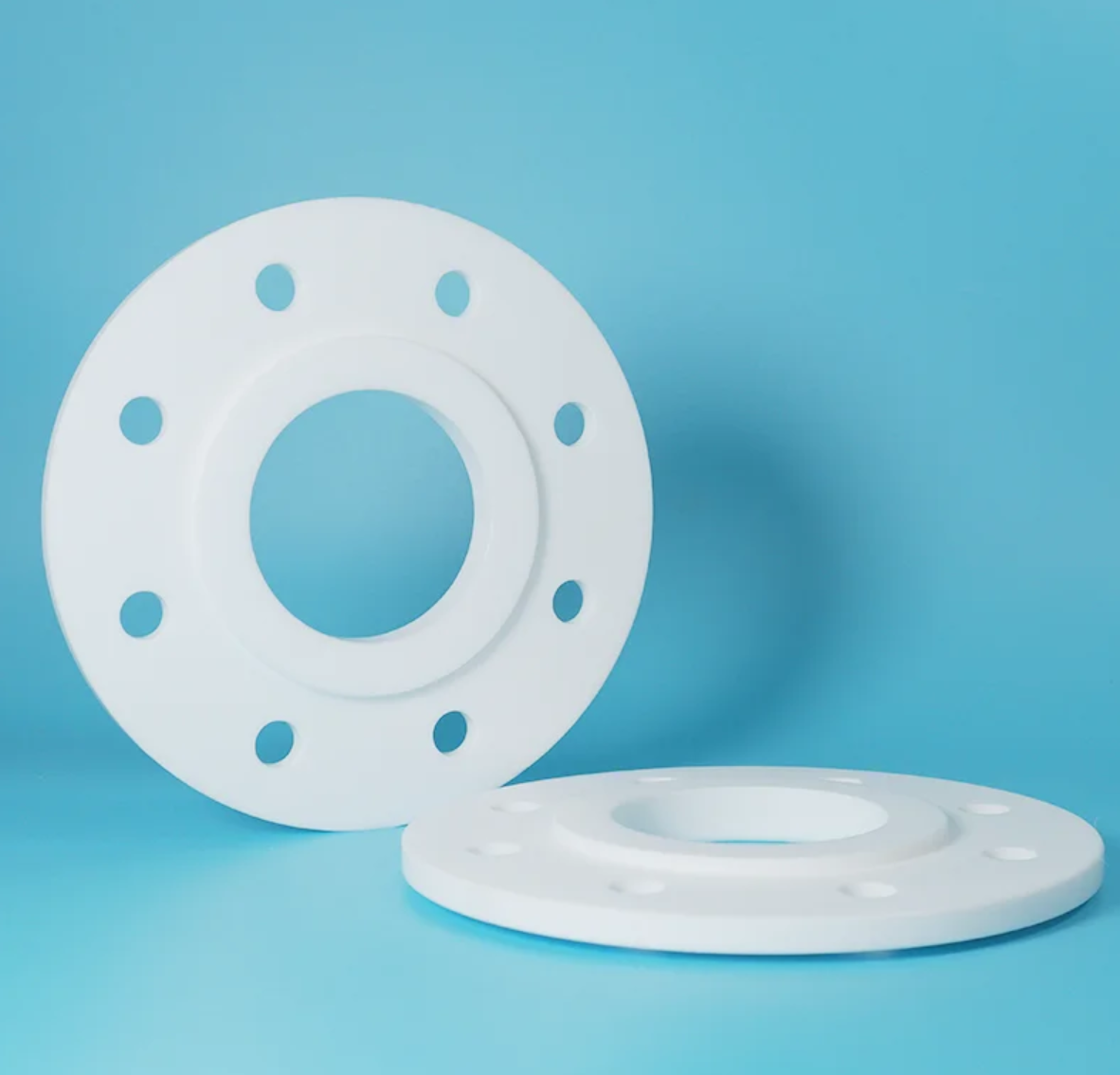
Custom PTFE shapes usually start with a mold, and molds eat time. By machining directly from PTFE sheet, rod, or tube, a shop can move from drawing to finished part in a few days instead of several weeks. There is no cavity to cut, no first-article wait, and no charge buried in the quote for tooling you may only use once.
That change opens up short-run work without the usual penalty. A stepped washer, a non-standard flange, or a wear strip with an unusual hole pattern can be produced to print, held to close tolerances, and adjusted quickly if the design shifts. The absence of a tool also means low-quantity orders do not carry the same upfront cost.
Material selection stays straightforward because common PTFE grades—virgin, glass-filled, carbon-filled, and mineral-filled—are already available in standard stock shapes. You choose the grade for the chemical exposure, temperature range, and friction requirements, not for what a molding house happens to run that month.
Virgin and Filled Grades for the Right Friction and Wear Profile
Friction and wear behavior rarely comes down to a single resin property; it reflects how the surface interacts with a counterface under load. Virgin grades tend to offer clean, predictable sliding behavior and are often the first choice for low-load bearings or guides where dimensional stability matters more than maximum wear resistance. However, their surfaces can develop stick-slip or transfer unevenly when speed and pressure climb.
Filled grades change that balance by modifying the contact zone. Glass fiber raises stiffness and load capacity, though it can make the grade more abrasive to softer mating parts. Carbon fiber adds both reinforcement and a mild lubricating effect, while PTFE and graphite work mainly as internal lubricants that lower friction and help stabilize the transfer film. The trick is to match the filler package to the failure mode: abrasive wear, adhesive wear, or friction spikes.
A useful starting point is to define the operating window before choosing between virgin and filled materials. Surface finish of the counterface, contact pressure, sliding speed, and whether the motion is continuous or intermittent all influence which formulation will hold up. Instead of assuming more filler is better, it is often more productive to run short-duration tests on two or three grades and compare wear depth, friction stability, and any visible transfer layer formation.
Wholesale Batches That Stay Consistent From Part to Part
Run after run, the same material lot is fed into the same fixtures, and every piece comes off the line within the same narrow window. That kind of repeatability is not an accident. It comes from locked tool offsets, surface finish checks at set intervals, and random draws for dimensional verification before anything gets packed.
Buyers who order in volume often worry that the first carton will look great and the next carton will drift. These batches are built to remove that worry. The goal is straightforward: a part pulled from the middle of the order should fit the same as a part pulled from the last box.
Small variations can still show up in raw stock, so incoming material is measured before it ever reaches the cutting or forming stage. If a coil or bar is slightly off, it gets adjusted or rejected rather than pushed downstream. The result is a wholesale run that holds its dimensions, finish, and feel from the first piece to the final pallet.
Sharp Threads, Flat Sealing Faces, and Burr-Free Edges
Thread engagement feels consistent from the first turn because the crests are cleanly formed rather than rounded over or smeared from dull tooling. That crisp geometry reduces the false tightness you sometimes get when a fitting binds early but never actually seats against the shoulder.
The flat sealing face matters once the threads have done their job. With a uniform contact area, the mating surface does not rely on a thick gasket or extra torque to fill in low spots. It sits flush, loads evenly, and tends to stay dry without repeated re-tightening.
Burr-free edges keep the part predictable after machining. There are no small slivers waiting to break off during handling or installation, and no raised ridge that keeps a mating component from seating fully. It is a small detail that becomes obvious the first time a connection goes together without resistance.
Direct Shop-Floor Communication From Quote to Delivery
A quote carries details that rarely survive the handoff to production. Special finishes, tolerance notes, and customer-specific packing instructions often sit in an email thread while the shop works from a stripped-down traveler. Direct shop-floor communication keeps the original quote attached to the order as it moves, so the person at the machine sees the same wording the customer approved—not a shortened version that invites guesswork.
When operators can flag material issues, actual run times, or tooling constraints back into the same record, the next quote stops repeating old mistakes. It works the other way too: delivery promises get adjusted from real progress instead of someone’s memory of how long a job should take. The floor is no longer reacting to a schedule built in isolation.
By the time an order reaches the dock, the packaging list, labels, and carrier instructions still trace back to what was quoted and confirmed weeks earlier. That continuity removes the usual last-minute scramble and makes the original estimate something the whole team can stand behind.
FAQ
Most parts leave our shop within plus or minus one thousandth of an inch on turned features, though flatness and thin walls can change that. We review the drawing first and tell you what is realistic before cutting.
Chemical processing, semiconductor equipment, food and beverage lines, medical devices, and fluid handling. PTFE shows up wherever aggressive media or low friction matter.
Fully custom is the norm. Send a drawing, sketch, or sample, and we quote from the geometry. We also refine designs for manufacturability when a feature looks problematic.
It is soft and moves with temperature, so holding tight dimensions with sharp tools and correct speeds matters. We often rough, normalize, then finish to let the material settle.
Prototypes usually ship in one to two weeks after drawing approval. Production runs depend on quantity and complexity, but three to four weeks is common.
Yes. We run anything from a handful of prototype pieces to repeat production lots, and we keep tooling and setup records so repeat orders stay consistent.
First article inspection, in-process checks, and a final dimensional report. Material certifications are available when the application calls for them.
Conclusion
Finding a shop that can hold tolerances on PTFE after the first article is not always straightforward, especially when the parts include thin walls or unusual profiles. This wholesaler approaches machined PTFE components as production work rather than one-off experiments. Custom shapes are cut directly from rod, sheet, or tube without waiting on dedicated tooling, which keeps lead times short for prototypes and full runs alike. The material options cover virgin PTFE as well as filled grades, so friction, wear, and compressive behavior can be matched to the actual operating conditions instead of settling for a generic stock choice.
Batch-to-batch consistency matters when the same part is ordered repeatedly, and that consistency extends beyond dimensions to surface finish and edge condition. Threads are chased cleanly, sealing faces stay flat, and edges come deburred without requiring extra handwork on the customer's side. Because communication runs directly with the shop floor from quote through delivery, questions about tolerances, material substitutions, or packing methods get answered without layers of back-and-forth. The result feels less like buying a catalog item and more like having a machining source that understands how PTFE behaves under load, temperature, and time.
Contact Us
Contact Person: Tommy Xiao
Email: [email protected]
Tel/WhatsApp: 8615651509888
Website: https://www.ptfe-factory.com