
Private Label Fluffy Socks Company for Cozy Brand Growth
2026-11-20
Fluffy socks are easy to copy, but hard to get right. Most brands treat them as a seasonal add-on and end up with thin, scratchy pairs that customers forget. If cozy is going to drive your brand growth, private label is where the real advantage starts—and it starts with a manufacturer that understands softness, fit, and consistency. KINDWAY helps brands turn that promise into repeat purchases.
The Fuzzy Sock Is the Sneaky Best-Seller in Private Label
Nobody in a Monday planning meeting would circle a basic fuzzy sock as the item most likely to carry a private label line. Yet it quietly outsells trendier accessories once temperatures drop. The reason is almost boring: people don't overthink a cozy sock. They toss a pair into the cart near checkout, grab a few extra as stocking stuffers, and come back for another set because the first pair wore out or disappeared in the dryer.
Private label programs love this item because the supply chain is forgiving and the margins stay healthy even at an impulse-buy price. A fuzzy sock doesn't ask for complicated sizing, hardware, or returns over fit. Buyers can order bold color-blocked runs, muted earth tones, or holiday motifs without worrying about deep fashion risk. That flexibility lets smaller brands test seasonal drops without committing to a full apparel line.
It also picks up a gift-giving role that keeps sales steady beyond the obvious winter spike. Housewarming bundles, spa-themed sets, teacher appreciation bags, or “just because” care packages all absorb these socks naturally. Customers may not talk about them the way they talk about a statement coat, but they keep buying them, and that repeat behavior is exactly what a private label wants.
Designing Warmth That Doesn't Look Like a Holiday Clearance Rack
Warmth in a room usually gets confused with adding another plaid blanket and calling it cozy. The result often feels less like a retreat and more like a seasonal aisle after a markdown frenzy. To avoid that, start with texture instead of themed color. A nubby wool throw in oat or charcoal, a boucle accent chair, or linen curtains with a soft drape do more than any reindeer motif ever could. The point is tactile comfort that feels deliberate, not like leftover decor.
The fastest way to tip into clearance-rack territory is through color. Cranberry, pine, and metallic gold have their place, but together they read as seasonal inventory. Pull the warmth from less expected places: faded terracotta, tobacco, oat, deep olive, and the kind of grey that leans brown at dusk. And don't worry about balancing them evenly. A room feels warmer when one or two muted earth tones take up most of the visual space and the rest quietly recede.
Then step back and cut anything that feels like it belongs on a shelf. You don't need a tiny evergreen on every table or a row of glitter candles lined up like stock. A single pair of worn brass candlesticks, a heavy wool rug, or a thick stoneware mug on a side table can hold more warmth than a dozen small decorations. Keep the surfaces spare and let the materials do the talking. That way the room feels wrapped in comfort, not waiting for a sale sign.
How to Make a Cozy Staple Feel Like a Brand Signature
Cozy staples usually fade into the background because they are designed to be easy. To make one feel like a brand signature, treat it like a logo. Choose a stubborn, recognizable detail—a contrast stitch along the neck, an off-center pocket, a cuff that folds back to show a hidden stripe—and repeat it on every version. Before long, people start to recognize that detail faster than a label.
Color is another lever. Instead of chasing a seasonal palette, anchor the staple in a shade that feels slightly off for its category: a dusty lilac hoodie, a bitter chocolate knit, a washed-out apricot crewneck. That small mismatch makes the piece feel owned rather than borrowed. Then let the cut carry the rest. A hem that stops an inch short, a shoulder that slouches just enough, a fabric weight heavier than expected—these choices make the garment identifiable from across a room.
Finally, show it the same way every time. Not as a stiff uniform, but through one repeated gesture: the sleeve tugged over the wrist, the front tucked on one side only, the collar left slightly open. That repetition turns a simple cozy item into a code people associate with the brand.
Finding a Factory Partner When Softness Is Your Whole Pitch
Softness is a stubborn thing to reproduce at scale. It sits in the finish, the fiber length, the twist of the yarn, and the way a factory stores unfinished fabric. When that feel is your whole pitch, a production partner has to care about it more than you do. You are not looking for capacity or a competitive quote first; you are looking for someone who argues with a dye house over a 3% change in hand feel and keeps a shelf of rejected samples like evidence.
Ask to see what didn't make the cut. A factory that can show you its failed trials is one that understands nuance. Ask how many wash cycles a sample goes through before approval, whether they check fabric from the beginning, middle, and end of a roll, and if they can name what makes a cotton feel fluffy rather than just heavy. The right shop won't hand you a spec sheet and wait for a nod. They'll rub the cloth between their fingers, compare it to a reference swatch, and tell you what needs adjusting before you ask.
Then make softness a checkpoint, not a slogan. Pack a reference swatch with every order and insist on a hand-feel check during pre-shipment inspection. If that request meets resistance, the partnership is not a fit. The factories worth keeping know that for your customer, the first touch is the product, not an afterthought.
What Makes Customers Reach for Fluffy Socks Before the Thermostat
Cold feet tend to announce themselves long before the room feels chilly. A hard floor pulls heat from the skin fast, and that sharp signal makes people want an immediate fix. Fluffy socks deliver warmth exactly where the discomfort starts, without waiting for a heating system to catch up or arguing over the dial. The speed of that comfort is often the real reason the sock drawer opens first.
There is also an unspoken trade-off at play. Heating an entire room asks for more energy and more time, while warming the feet only asks for a layer of soft fabric. Customers seem to recognize this without turning it into a lecture about efficiency. They simply notice that thick socks solve the immediate problem well enough, so the thermostat can stay put for another hour or two.
Then there is the texture itself. A plush lining against the skin changes the mood of an evening, making a cool apartment feel less like a drafty box and more like a place worth settling into. The choice stops being about giving up warmth and becomes a small act of self-care, which is far easier to reach for than a temperature setting.
From Single SKU to Cozy Brand Without Overcomplicating It
Most founders assume a cozy brand needs a full product line from day one. But the fastest route to warmth and recognition often starts with a single, well-loved item. Think of your first SKU as the handshake, not the entire conversation. Instead of chasing variety, pour your energy into making one product so dependable that customers start to describe it as “the one I always reach for.” That specific, almost personal attachment is what later turns a lone purchase into a repeat habit.
Once that first SKU earns trust, let the next additions grow from real customer habits rather than a branding checklist. Maybe people keep asking for a larger size, a refill option, or a neutral color that matches their morning routine. Those requests are clues. A cozy brand is rarely built by shouting “comfort” in every headline; it grows when each new product feels like a natural extension of the first one — same textures, same quiet consistency, same reason to stay.
The trap is to overcomplicate too early. You don’t need a dozen variants, a rebrand, or a complicated bundle strategy to feel established. You need one clear promise repeated with care. When the path from first SKU to cozy brand stays simple, each launch feels less like a gamble and more like adding another chair to a room people already enjoy sitting in.
FAQ
They let you shape the product around the mood you're already selling. Instead of forcing generic socks into your line, you pick the yarn weight, the color palette, and the little details that match your brand's idea of comfort. That kind of control usually feels out of reach for smaller labels, but with private label options it becomes practical.
Look for someone who asks about your customer before talking about quantities. A good partner will want to know where the socks will be worn, how soft they need to feel, and what kind of packaging you're planning. Clear communication about lead times and sampling matters more than a glossy catalog.
You can adjust the cuff height, choose a marled or solid yarn, add cushioned soles, or use contrast stitching on the toe and heel. Even the inside label can become part of the experience if you print a short message or care note there.
Blends that pair acrylic or polyester with a bit of spandex tend to hold their shape while staying soft. Some brands lean into brushed yarns for a cloud-like surface. If you want to talk about natural fibers, a cotton-rich option can feel breathable but may lose the fluff factor more quickly.
Not always. Many private label programs now offer tiered ordering or lower minimums for the first run. It is still wise to ask about setup fees, color minimums, and whether the factory keeps your chosen yarn in stock so reorders do not start from zero.
Packaging is often the first physical touchpoint. A simple recyclable band, a soft-touch hang tag, or a belly band with a handwritten-style message can make the socks feel like a small gift rather than just another pair. The goal is to keep the unboxing calm and warm.
Unexpected color blocking, a slightly slouchy fit, ribbed cuffs that do not pinch, or a subtle pattern on the sole can help. Avoid chasing every trend; a small signature detail repeated across the collection is usually more memorable.
It depends on whether you are starting with an existing blank or creating a fully custom yarn. Sampling can take a few weeks, production might run another four to six weeks, and shipping can add a week or more. Build in a buffer for changes so the timeline does not feel rushed.
Conclusion
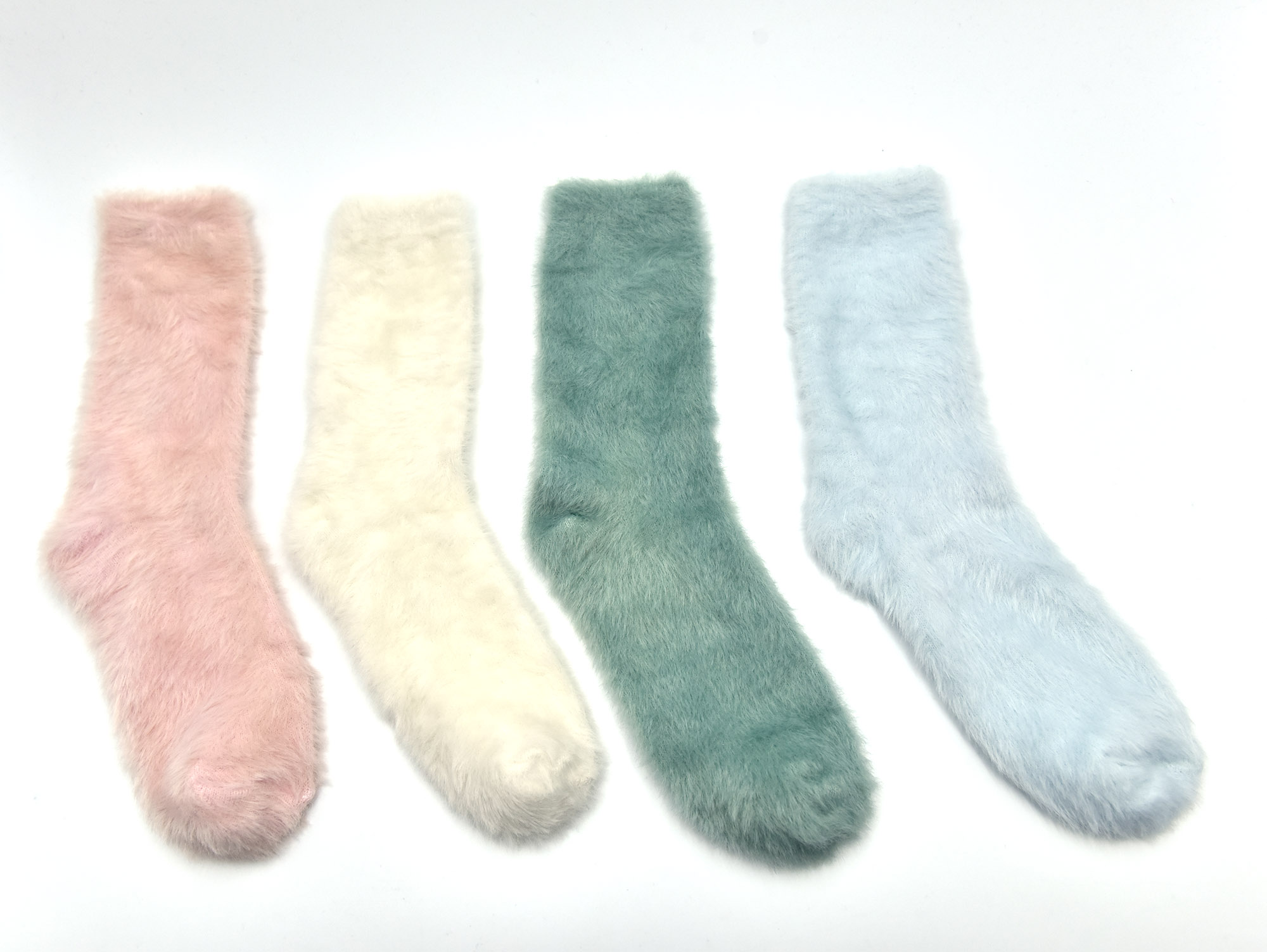
Fluffy socks rarely get the credit they deserve in a private label lineup. They sit at the edge of the catalog, treated as a winter afterthought, yet they quietly outperform flashier accessories because they solve an immediate physical need and get reordered without much persuasion. The trick is to design them like a considered product rather than a holiday novelty. That means skipping glitter threads, snowflake prints, and harsh reds in favor of heathered neutrals, soft vegetable-dye tones, and ribbed cuffs that hold their shape after washing. Small choices like a flat toe seam or a slightly taller shaft make the sock feel intentional, and those details are what turn a generic fuzzy sock into a recognizable brand object instead of something pulled from a clearance bin.
The same restraint should guide factory conversations. When softness is the entire pitch, a supplier needs to prove how the yarn behaves after repeated washes, not just how it feels in a sample. Ask for wash-tested swatches, fiber length data, and examples of pilling after normal use. Once that foundation is solid, growth can stay simple: start with one excellent core SKU, then expand into muted seasonal color drops, a lighter summer weight, or a matching lounge piece only when the fit and finish feel stable. Customers already reach for these socks before touching the thermostat because warmth has become a small daily ritual, not a seasonal purchase. A private label brand that respects that ritual can build loyalty around a product most people underestimate, which is exactly where the margin and repeat demand live.
Contact Us
Contact Person: Alfred Lee
Email: [email protected]
Tel/WhatsApp: +86 13806701496
Website: https://www.hainingsocks.com/