
Top Geotextile Fabric Options for Durable Ground Stabilization and Drainage
2026-10-13
Every civil engineer knows the sinking feeling of watching a well-planned project stall because the ground just won’t cooperate. Whether it’s rutting under heavy loads or water pooling where it shouldn’t, poor stabilization and drainage can turn a straightforward build into a costly headache. That’s where the right geotextile fabric comes in—and not all options are created equal. From woven monofilaments to needle-punched nonwovens, the choices can feel overwhelming. At JInseed Geosynthetics Solution, we’ve spent years helping contractors cut through the confusion. In this guide, we break down the top geotextile fabric options for durable ground stabilization and drainage, so you can lay a foundation that actually lasts.
Woven Fabrics That Hold Up Under Heavy Ground Loads
Under a fully loaded dump truck or a stack of shipping containers, the ground doesn't just press down—it shifts, stretches, and tries to tear whatever lies beneath the surface. Woven fabrics made for these conditions earn their keep by turning that punishing load into a wider, more stable footprint. The tight over-under structure of the yarns resists elongation, so ruts don't form as quickly and the base layer stays put.
Not all woven fabrics handle heavy loads the same way. High-tenacity polypropylene or polyester yarns are common here, but the real difference comes down to weave density and tensile strength. A fabric with low elongation and high grab strength will bridge soft subgrades without ripping, while its open enough weave still lets water pass instead of building up pressure. That combination matters more than thickness alone.
On site, it helps to think of these materials as a tension membrane rather than a simple separator. When placed over weak soil and covered with compacted aggregate, the fabric stretches just enough under load to lock the stone together, creating a reinforced platform that can carry repeated traffic. Seams and overlaps need the same attention as the main body—most failures trace back to edges pulling apart, not the center giving way.
Nonwoven Geotextiles for Drainage Without Clogging
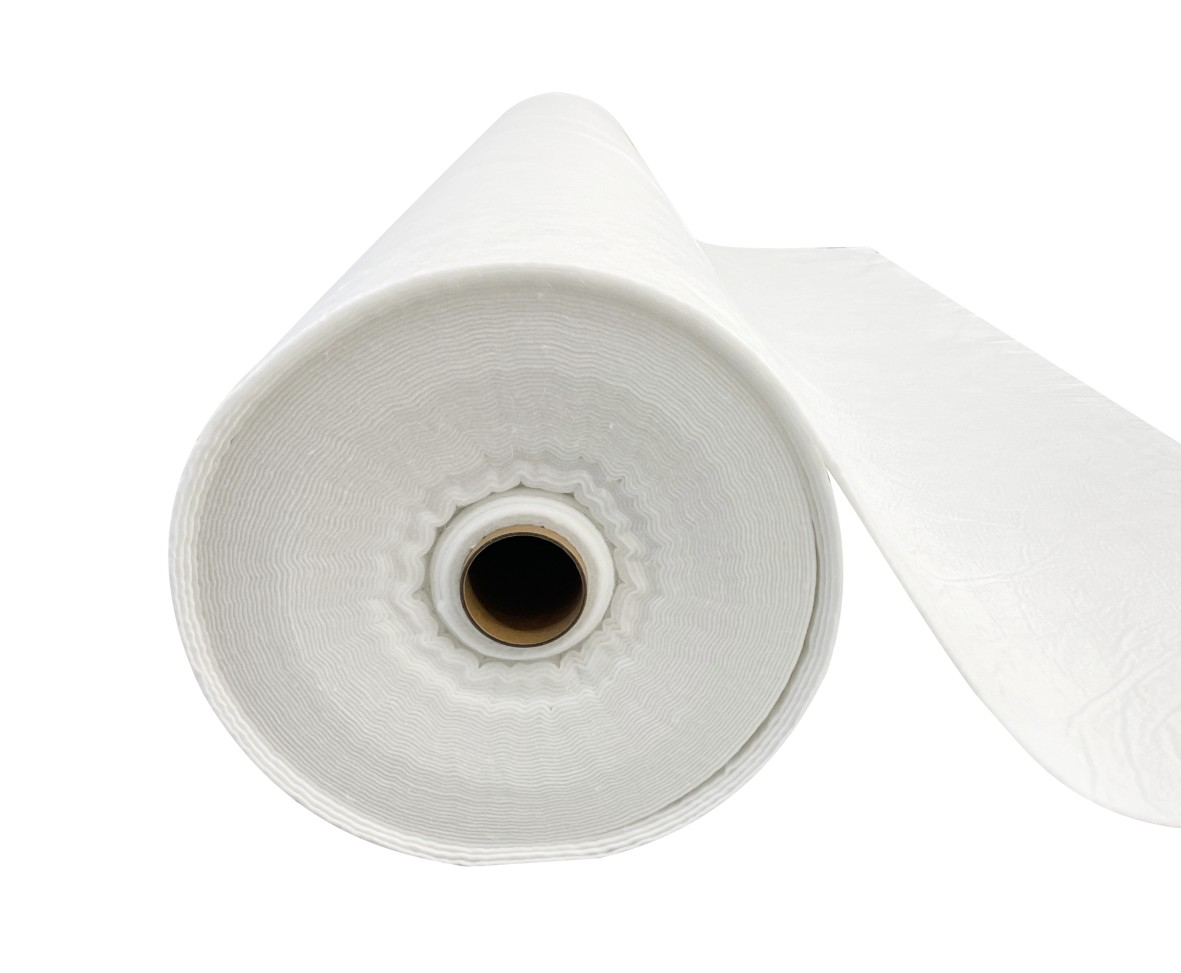
Nonwoven geotextiles used in drainage applications rely on a random fiber matrix rather than a uniform weave. This structure creates thousands of small, tortuous channels that let water pass while trapping soil particles on the upstream side. Unlike woven fabrics with fixed openings, a needle-punched nonwoven can adjust its pore size under load and still maintain a high flow rate because the fibers move slightly without collapsing the entire filter plane.
Clogging usually happens when fine particles lodge inside the fabric or build a low-permeability cake on its surface. Nonwovens reduce this risk through thickness and graded density: the outer layers have larger pores to catch coarser grains, while the inner layer remains open enough for water to escape. This depth filtration effect prevents a single blinding layer from shutting down the drain. High elongation also lets the fabric conform to uneven subgrades without tearing or creating preferential flow gaps.
Field performance depends on matching the geotextile to the surrounding soil gradation and hydraulic gradient. For silty or clayey soils, a heavier nonwoven with a smaller apparent opening size is often needed, but it should still be checked with long-term flow tests rather than just index values. Installation should avoid folding or stretching the fabric across drainage stone, and seams need enough overlap to keep soil from piping at the edges. When selected correctly, a nonwoven geotextile can keep a trench drain, footing drain, or retaining wall weep working for decades without manual cleaning.
Composite Layers That Combine Filtration and Reinforcement
In many civil and environmental applications, a single material rarely handles both particle retention and structural stress at the same time. Composite layers fill that gap by pairing a filter medium with a high-strength reinforcement grid. A needle-punched nonwoven geotextile laminated to a woven scrim, for example, keeps fine soil particles from migrating while still holding its shape under tensile load.
The way these layers are bonded matters just as much as the materials themselves. Thermal bonding, needle punching, or stitch bonding creates a mechanical interlock that prevents delamination during installation or service. Some designs also include a drainage core between the filter and reinforcement, letting water move laterally while the reinforcement carries pressure from soil or pavement. This type of construction shows up in soft-ground roadways, landfill drainage layers, and erosion control mats.
When selecting a composite layer, engineers often look beyond basic specifications to indicators like gradient ratio, long-term creep resistance, and chemical durability. Filtration and reinforcement do not act independently: if the filter clogs, localized pore pressure can lift the reinforcement; if the reinforcement deforms too much, the filter may tear. Evaluating the two functions as one integrated system, rather than adding up separate performance numbers, gives a more reliable picture of how the composite will behave in the field.
UV-Stable Options for Exposed Slopes and Temporary Roads
Geosynthetic materials used on exposed slopes and temporary roads face relentless ultraviolet exposure that can silently degrade polymer chains within months. While standard polypropylene and polyester products often lose tensile strength before project completion, UV-stabilized alternatives incorporate hindered amine light stabilizers or carbon black dispersions that interrupt photo-oxidation cycles. These additives are not surface coatings but are integrated into the resin during extrusion, ensuring protection persists even after abrasion from traffic or slope movement. Field experience on high-altitude haul roads shows that such stabilized geotextiles retain over 80% of their initial strength after two years of direct sunlight, whereas unstabilized versions may fall below 50% within half that time.
Choosing the right UV-stable option depends on the exposure geometry and operational lifespan. For temporary roads that will be covered with aggregate within weeks, a stabilization package rated for 6 to 12 months is often sufficient and cost-effective. However, exposed slope facing systems—such as erosion control blankets with synthetic nets or mechanically stabilized earth wraps—demand products tested to 3,000 hours or more under accelerated weathering protocols like ASTM D4355. Manufacturers typically report the percentage of strength retained after a specified xenon-arc exposure, and that figure should guide selection rather than vague marketing terms like "UV resistant." A practical rule is to require at least 70% retained strength after 1,000 hours for any application where the geosynthetic remains visible for more than one construction season.
Beyond material choice, detailing can extend the functional life of UV-stable geosynthetics on steep slopes. Covering the top anchor trench with native soil or a sacrificial geotextile flap reduces direct radiation at the most stressed transition zone. On temporary haul roads, scheduling aggregate placement immediately after geotextile installation minimizes cumulative UV dosage. For long-term exposed applications, consider pairing a UV-stabilized base layer with a dark-colored erosion control mat that inherently absorbs less damaging short-wave radiation. These combined measures, grounded in photodegradation mechanisms rather than generic best practices, help ensure that temporary roads and exposed slopes remain stable through multiple weather cycles without premature material replacement.
Polypropylene or Polyester: Which Base Polymer Lasts Longer?
When you put polypropylene and polyester side by side under the same wear-and-tear conditions, the difference in lifespan often comes down to how each polymer handles moisture, UV exposure, and repeated flexing. Polypropylene tends to have a slight edge in chemical resistance and doesn't absorb water, which means it won't weaken from dampness or mildew the way polyester can over long stretches in humid environments. But that advantage narrows quickly outdoors: polypropylene degrades faster under direct sunlight unless it's heavily stabilized, while polyester holds up better against UV rays and retains more of its tensile strength after years of exposure.
Another factor that separates the two is abrasion resistance. Polyester fibers generally withstand rubbing and friction better than polypropylene, so items like ropes, outdoor furniture straps, and luggage shells made from polyester often show less surface wear after heavy use. Polypropylene, on the other hand, tends to be more brittle in cold temperatures and can crack or split under repeated stress, especially if the part is thin or molded with sharp corners. That said, polypropylene's low density and superior fatigue resistance in living hinges—like the thin plastic strips on bottle caps—give it a unique longevity in specific applications where polyester would simply fail from repeated bending.
In the end, there's no universal winner. For indoor or damp environments where chemical exposure and moisture are the main threats, polypropylene usually lasts longer. For outdoor exposure, high abrasion, or cold-weather flexibility, polyester is the safer bet. The base polymer alone doesn't determine lifespan—additives, stabilizers, and the manufacturing process can shift the balance significantly—but understanding these core differences helps you pick the material that won't give out early.
Matching Fabric Weight and Pore Size to Soil Type
Heavier fabrics, usually above 4 ounces per square yard, hold up better under gravel driveways or pathways where sharp stones and constant pressure are part of daily life. Lighter weights work fine beneath mulch in planting beds, but they tear more easily if you try to stretch them under rock. The trick is matching the fabric's toughness to what sits on top of it rather than assuming one thickness works everywhere.
Pore size matters more than many people expect. A tight weave or small pore size stops fine silt and clay from washing through, but it can also slow down water movement enough to create puddles after heavy rain. On sandy or loamy ground you can use a fabric with slightly larger openings and still get good soil retention while keeping drainage quick. For heavy clay, choose a fabric with a smaller pore size and pair it with a coarse aggregate layer so water has somewhere to go instead of pooling on the surface.
Before buying, take a handful of the soil from the site and rub it between your fingers. If it feels gritty and falls apart, it drains freely and a mid-weight fabric with moderate pore size will do the job. If it forms a sticky ribbon when wet, you are dealing with clay and need both a heavier fabric for tear resistance and a finer pore size to keep that clay from migrating upward into your stone or mulch. Matching these two properties to the soil type saves you from replacing the fabric a season later.
FAQ
Geotextiles generally fall into woven, nonwoven, and knitted types. Woven fabrics have high tensile strength and low elongation, so they're great for reinforcing weak soil under roads or foundations. Nonwoven fabrics, especially needle-punched ones, offer better water flow and are ideal for drainage and filtration. Knitted geotextiles are less common but can combine properties of both. For heavy stabilization, go woven; for drainage, go nonwoven.
Nonwoven geotextiles have a felt-like structure with many small pores that let water pass while holding back soil particles. This keeps drainage systems from clogging over time. Their thickness also creates a cushion, which helps in wet, soft ground where water needs to move laterally into pipes or gravel drains.
Yes, woven geotextiles are engineered for that. Their interlaced yarns give them high tensile strength and minimal stretch, so they can distribute heavy vehicle loads over a wider area. That reduces rutting and subgrade deformation. Just make sure the fabric's grab tensile and tear strength match your expected traffic loads.
First, check the subgrade strength and expected traffic. For weak soils, a heavier woven or high-strength nonwoven is best. Look at the fabric's permittivity for drainage, grab tensile for tear resistance, and UV stability if any part will be exposed during construction. Also, consider installation ease—lighter fabrics are easier to handle, but don't sacrifice needed strength.
Generally, heavier geotextiles (measured in ounces per square yard or grams per square meter) resist punctures, tears, and installation damage better. A 6-8 oz nonwoven works for moderate drainage and separation, but for aggregate roads with heavy trucks, you might need 10 oz or more. Weight alone isn't everything—polymer type and bonding method matter too.
Start with a smooth, compacted subgrade free of sharp objects. Roll the fabric out flat, overlapping seams by at least 12-18 inches, and secure it with pins or staples. Avoid dragging aggregate directly over the fabric; instead, place a thin initial lift of gravel and spread carefully. Then build up the rest in layers, compacting each lift.
Some manufacturers now use recycled polyester or polypropylene from post-industrial waste. These fabrics perform similarly to virgin materials in separation and drainage applications while reducing landfill burden. Look for certifications or supplier data on recycled content. Natural fiber geotextiles like coir or jute exist too, but they degrade over time, so they're better for temporary erosion control than permanent stabilization.
Choose the right fabric for your soil type—if fine silts or clays are present, a nonwoven with smaller apparent opening size (AOS) prevents clogging. During installation, keep equipment from turning on the fabric, use enough overlap, and cover it quickly to avoid UV degradation. For rocky subgrades, use a heavier fabric or add a sand cushion to reduce puncture risk.
Conclusion
Choosing the right geotextile for ground stabilization and drainage often comes down to how well the fabric balances strength and water flow. Woven fabrics, constructed from tightly interlaced yarns, handle heavy ground loads without tearing, making them a go-to for reinforced bases under roads or parking areas. Nonwoven options, on the other hand, are designed to let water pass through while keeping soil particles in place, which prevents clogging and maintains drainage over time. For projects that demand both functions, composite layers pair a filtration fabric with a reinforcement grid, offering a single solution that supports structural loads and still manages moisture effectively.
Beyond the basic weave, durability under real-world conditions hinges on a few practical details. UV-stable geotextiles are worth considering for exposed slopes and temporary roads, since prolonged sunlight can degrade untreated fabrics quickly. The choice between polypropylene and polyester also influences lifespan; polypropylene generally resists chemical and biological breakdown, while polyester offers a bit more stiffness and higher temperature tolerance. Finally, matching fabric weight and pore size to the surrounding soil type prevents premature failure—heavier fabrics suit coarse, angular soils, whereas finer nonwovens work better with silty or clay-rich ground. Taking these factors together gives you a geotextile selection that stays functional long after installation, without constant maintenance or replacement.
Contact Us
Contact Person: Jerry Qiu
Email: [email protected]
Tel/WhatsApp: +65 84265294
Website: https://www.jinseed-geo.com