

Top PET Geotextile Solutions for Reliable Soil Reinforcement and Drainage
2026-10-21
Most soil reinforcement failures aren't caused by weak geotextiles—they're caused by choosing the wrong type for the site's hydraulic and load conditions. PET geotextiles now offer a practical middle ground between stiffness and permeability, but the market is flooded with generic claims. What actually matters: fiber bonding, puncture resistance, and pore size distribution. At WEN FENG STONE, we focus on these overlooked details, supplying PET solutions that perform under repetitive stress and high water flow. In the following guide, we break down the top PET geotextile configurations for reliable soil reinforcement and drainage—so you can avoid costly guesswork.
Continuous-Filament PET Yarns and Their Advantage Under Repetitive Loading
Continuous-filament PET yarns behave differently from spun yarns when subjected to cyclic stress. Because the individual filaments run uninterrupted along the entire length, load transfer does not rely on fiber-to-fiber friction. Instead, each filament participates directly in carrying the applied force, which reduces localized stress concentrations that typically develop at staple fiber ends. Under repeated loading, this structural continuity allows the yarn to distribute tension more evenly, so early fatigue failures are less likely to initiate at weak points.
The molecular orientation and crystallinity of PET contribute further to its performance under repetitive loading. Drawing during production aligns the polymer chains, giving the yarn a high modulus and good elastic recovery. When load is applied and removed many times, the material tends to return close to its original length, provided the strain stays below the yield point. This recovery behavior means continuous-filament PET can endure thousands of load cycles without the progressive elongation or permanent set that often plagues less oriented structures.
Practical applications highlight this advantage clearly. In industrial slings, conveyor belts, and geotextile reinforcements, continuous-filament PET yarns retain their dimensional stability and strength far longer than alternatives under pulsating or vibrating loads. The absence of short fiber ends also limits abrasion-induced filament breakage, which is a common fatigue trigger. As a result, designers favor these yarns where repeated tension, flexing, or impact is part of normal service, knowing the material will not gradually lose integrity through the same mechanisms that degrade staple-spun products.
How Needle-Punched Pore Structures Keep Drainage Paths Open
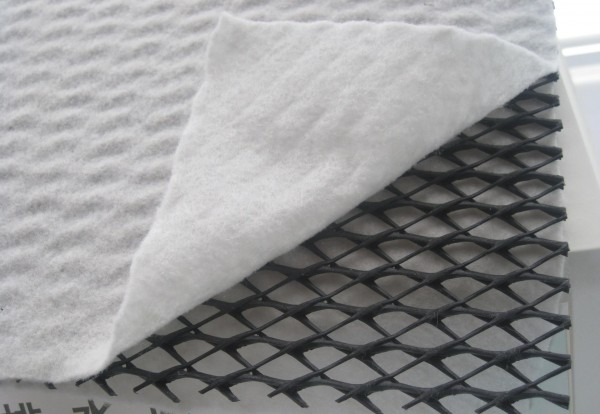
Unlike flat woven or heat-bonded fabrics that tend to collapse under heavy load, needle-punched materials create a tangled, three-dimensional fiber matrix. Each barbed needle drives fibers vertically through the web, locking them in place and forming small, irregular channels that resist closure when compressed. These channels stay open because the fibers act like tiny springs, pushing back against soil pressure and maintaining a continuous path for water to move through.
As water flows through the fabric, the pore structure does more than just allow passage—it actively filters out fine particles that might otherwise clog the drainage layer. The varied pore sizes, created by the needle penetration pattern, trap sediment near the surface while leaving deeper pathways clear. Over time, this means less buildup and more reliable drainage, even in silty or clay-heavy ground where finer soils tend to migrate.
Field performance often comes down to how well the material handles repeated loading. With needle-punched pore structures, the fabric retains much of its original thickness and void volume after heavy compaction or traffic. That resilience keeps the drainage paths open not just right after installation, but for years of service, making it a practical choice for retaining walls, road edges, and landfill drainage systems.
Soft Subgrade Stabilization Without the Cost of Over-Excavation
Stabilizing soft subgrade often conjures images of massive earthwork, long haul routes, and budgets blown before the first layer of pavement goes down. But over-excavation isn't the only answer. Chemical and mechanical stabilization methods can transform weak, moisture-sensitive soils in place, eliminating the need to dig out and replace them. Lime, cement, fly ash, or proprietary binders are mixed directly into the upper subgrade, altering its plasticity and load-bearing behavior. The result is a firmer working platform that supports construction traffic and spreads applied loads without the deep cut.
The real savings come from what you don't do. No digging means no disposal fees, no imported fill, and no extended lane closures from truck after truck rumbling through the site. Geosynthetics add another layer of value by reinforcing the stabilized layer, bridging weak spots that chemical treatment alone might miss. A geogrid or geotextile placed at the subgrade interface mechanically locks aggregate into place, reducing rutting and keeping the section thinner than a conventional dig-out would require.
Site conditions dictate which combination works best. High-plasticity clays respond well to lime, which dries the soil and breaks down its expansive structure. Silty or sandy subgrades often gain more from cement or a blended binder that sets quickly even in damp weather. Before committing, run a simple pH test and a few Proctor curves on treated samples. The upfront lab work costs a fraction of over-excavation and gives you a mix design that can be verified in the field with lightweight deflectometers or proof rolls. When the numbers line up, in-place stabilization turns a soft subgrade from a project liability into a stable base that carries the pavement through years of traffic.
Filter Performance of PET Geotextiles Against Silt and Clay Migration
Needle-punched PET geotextiles exhibit a filtration mechanism that depends heavily on their apparent opening size and pore structure. Under constant head conditions, silt particles larger than roughly 70 microns tend to be retained by the fabric surface or within the fiber matrix, forming a bridging network that gradually reduces the effective opening size. Clay-sized particles, by contrast, are small enough to pass through the initial pore openings unless a filter cake develops. In practice, a fabric with an AOS between 100 and 150 microns often shows early-stage turbidity in the effluent, followed by a sharp drop in particle passage as the retained silt creates a more restrictive interface.
Gradient ratio tests on PET geotextiles placed against silty clay soils reveal a non-linear relationship between flow rate and particle migration. At low hydraulic gradients, cohesive clay flocs may settle within the fabric's void space without significant breakthrough, while at higher gradients, dispersed clay platelets can migrate through the matrix and exit as a cloudy suspension. The fabric's thickness and fiber orientation play a role here: needle-punched PET with high loft tends to trap more fine particles internally, reducing downstream turbidity but also increasing the risk of internal clogging over time.
Long-term performance is not solely dictated by initial particle retention. Biological slime growth, chemical precipitation, and compaction under soil load can all reduce through-flow capacity even when the geotextile initially passed clean water. In field installations, monitoring of outflow clarity after the first few storm events gives a better indication of sustained filtration than laboratory permittivity alone. For critical drainage applications, a sacrificial layer of coarser sand placed against the geotextile often helps preserve long-term filter function without sacrificing initial permeability.
Riprap Placement Demands Higher Puncture Resistance Than Standard Fabrics Offer
Riprap placement involves dropping heavy, angular stone directly onto the prepared subgrade, often from heights of several feet. This sudden impact concentrates force at sharp edges and points. Standard nonwoven geotextiles, while adequate for separating soil and aggregate under gentle loading, can tear or puncture during this dynamic process. The repeated striking of stone corners against a fabric that lacks sufficient puncture resistance leads to immediate holes, compromising the separation and filtration functions before the project even moves into service.
Beyond the initial drop, riprap construction equipment and worker foot traffic exert additional stress. The fabric must survive not just the first stone contact, but dozens of subsequent impacts as material is spread and adjusted. Fabrics with only moderate puncture strength may appear intact after placement but contain hidden breaches that allow fine soil particles to migrate upward into the stone voids. Over time, this piping action undermines the riprap layer and can cause settlement or localized failure along slopes and channels.
Specifying a geotextile with high puncture resistance is therefore not a conservative luxury but a practical necessity for riprap systems. Tests such as ASTM D4833 or D6241 measure the force required to rupture a fabric under a standardized probe. However, real-world performance depends on matching that rating to the maximum stone size and drop height. A fabric that passes a low-energy puncture test in the lab may still fail during aggressive construction. Engineers and contractors should select materials with puncture values well above the estimated impact energy, rather than relying on standard separation fabrics never intended for this punishing environment.
Polyester Geotextile Strength Retention in Acidic and Alkaline Soil Conditions
Polyester geotextiles are widely chosen for reinforcement and separation in environments where chemical exposure is a concern, but their long-term strength depends heavily on soil pH. In moderately acidic conditions, polyester fibers generally hold up well because the polymer chain is relatively resistant to proton attack. However, once pH drops below about 4, hydrolytic degradation can begin to reduce tensile strength, especially when moisture and elevated temperatures are present. Alkaline soils pose a more immediate risk: the ester linkages in polyethylene terephthalate are vulnerable to alkali hydrolysis, leading to surface etching and a gradual loss of load-bearing capacity even at pH levels as low as 9. This makes pH monitoring a practical necessity for projects in limestone-rich or lime-treated ground.
Field and laboratory studies often report that polyester geotextiles retain 80–90% of their initial strength after several years in neutral soils, but retention can fall below 60% in strongly alkaline conditions within the same period. The rate of degradation is not linear; an initial slow phase is followed by accelerated strength loss once the fiber surface becomes roughened and more susceptible to further chemical attack. Acidic environments below pH 3 can produce similar acceleration, though such conditions are less common in natural soils. To improve durability, some manufacturers apply proprietary coatings or use higher molecular weight polymers, yet these measures only delay rather than eliminate the underlying hydrolysis reaction.
Designers should avoid assuming that all synthetic geotextiles behave alike. When specifying polyester for landfills, mine tailings, or agricultural drainage where pH extremes are expected, it is prudent to request accelerated aging test data that replicate the specific soil chemistry and moisture regime. Additionally, combining polyester with a protective sand layer or adjusting the drainage design to reduce prolonged saturation can significantly extend useful life. In borderline cases, switching to a polypropylene geotextile may be justified for highly alkaline sites, though polyester still offers advantages in tensile stiffness and creep resistance under moderate pH conditions.
FAQ
PET fibers have a naturally high tensile strength and don't stretch much under load, so the soil layer stays locked together even when traffic or fill pressure increases. Unlike some woven fabrics that tear easily at installation, PET geotextiles tend to survive rough handling and keep their structure over a longer service life.
The fabric is designed with enough open area to let water pass through freely, while the fiber network holds soil particles in place. That combination prevents fine material from washing out and keeps the base layer from turning into a soft, unstable mess after heavy rain. It's less about blocking water and more about controlling where the soil goes.
You'll see the biggest payoff in road bases, parking areas, slope stabilization, and retaining wall backfill. Anywhere the ground has to resist both vertical loads and lateral movement, a PET geotextile can add that extra margin of safety. It's also useful under erosion control blankets where long-term durability matters more than quick biodegradability.
It depends on the subgrade and the expected load, but many road and foundation projects do well with PET geotextiles in the 200 to 400 g/m² range. Lighter fabrics are fine for separation and drainage, while heavier ones handle more aggressive aggregate placement and higher stress. Always match the fabric to the weakest soil condition you expect, not the average.
PET has good resistance to biological attack, mild acids, and alkalis, which makes it suitable for soils that would degrade other synthetics. It's not indestructible, though—prolonged exposure to strong UV light or sharp rock edges can still cause damage. Burying the fabric quickly and using a protective sand layer when needed goes a long way.
First, verify the subgrade is smooth and free of large roots, sharp stones, or standing water. Then confirm the roll direction and overlap width match the design drawings. A quick visual check for tears, creases, or wet storage damage can prevent weak spots that only show up after the aggregate is already spread.
PET generally offers higher tensile strength and better creep resistance, meaning it doesn't slowly elongate under constant load the way some polypropylene fabrics can. That's important when the soil has to hold its shape for years under parked trucks or heavy equipment. The trade-off is usually a slightly higher upfront cost, but the long-term stability often justifies it.
Overlaps typically need at least 300 to 450 mm, depending on the slope and soil type. On very soft ground, you may need to pin or staple the overlap before covering it with aggregate so wind or construction traffic doesn't shift the fabric. Seams can be sewn or heat-bonded, but in most non-critical applications a generous overlap is enough to keep the system acting as one continuous layer.
Conclusion
Continuous-filament PET yarns hold up far better than short-fiber alternatives under repeated traffic and cyclic loading, which is why they show up in temporary haul roads and working platforms over soft ground. The needle-punched pore structure creates a tortuous, three-dimensional void network that resists clogging and keeps drainage paths open even when fines are pushed into the fabric. On weak subgrades, this allows a single layer of high-modulus PET geotextile to replace over-excavation, cutting both cost and schedule. The pore size distribution is tuned to block silt and clay migration while letting water pass, so the aggregate base stays clean and pumping at the surface is reduced.
Where riprap or heavy stone must be placed, ordinary separation fabrics puncture too easily under angular rock drops, so PET geotextiles are specified with higher puncture and tear resistance to survive installation abuse. Long-term durability in aggressive soils is another differentiator: polyester retains most of its tensile strength across a wide pH range, unlike some synthetics that degrade in acidic or alkaline conditions. Together these properties make PET geotextiles a dependable choice for filtration, separation, reinforcement, and drainage in demanding civil works.
Contact Us
Contact Person: Jennifer LEE
Email: [email protected]
Tel/WhatsApp: 8618553418999
Website: https://vip.e-baixing.com/wenfengshitong