
Vertical Lift Rack Zinc Plating Equipment for Reliable Metal Finishing
2026-08-30
Every metal finisher knows the frustration of uneven coatings and costly downtime. That’s why Junda engineered its vertical lift rack zinc plating equipment to deliver precision, consistency, and long-term reliability. In this post, we’ll break down the features that set this line apart—and why it’s the practical choice for shops serious about quality metal finishing.
Why Vertical Lift Beats Barrel Plating for Fragile Metal Parts
The tumbling action inside a rotating barrel creates constant part-to-part contact and occasional hard impacts. For thin-walled sleeves, delicate threads, stamped connectors, or fine surface finishes, those collisions lead to bent edges, nicked threads, and scratched exteriors. Vertical lift systems avoid that by holding parts on dedicated racks or fixtures and moving them straight up and down through the bath, so individual pieces never slam into one another.
Another issue with barrel plating is the dead zone at the center of the workload. Fragile parts packed deep in a barrel receive uneven current distribution, resulting in thin or burned deposits on already vulnerable features. Vertical lift agitation keeps the solution flowing uniformly across each part while the controlled vertical stroke continuously refreshes the plating zone. That produces consistent thickness on recessed areas without forcing the part to withstand tumbling stress.
For parts with tight dimensional tolerances or fragile geometry, even minor deformation from barrel rotation can push them out of spec. Vertical lift handling lets the plating rack take the mechanical load, not the part surface. There is no cascading weight, no rolling contact, and no need to over-plate to compensate for damage. The result is a higher yield, fewer touch-ups, and plating that preserves fragile details instead of rounding them off.
Rack Geometry Tweaks That Improve Zinc Thickness Uniformity
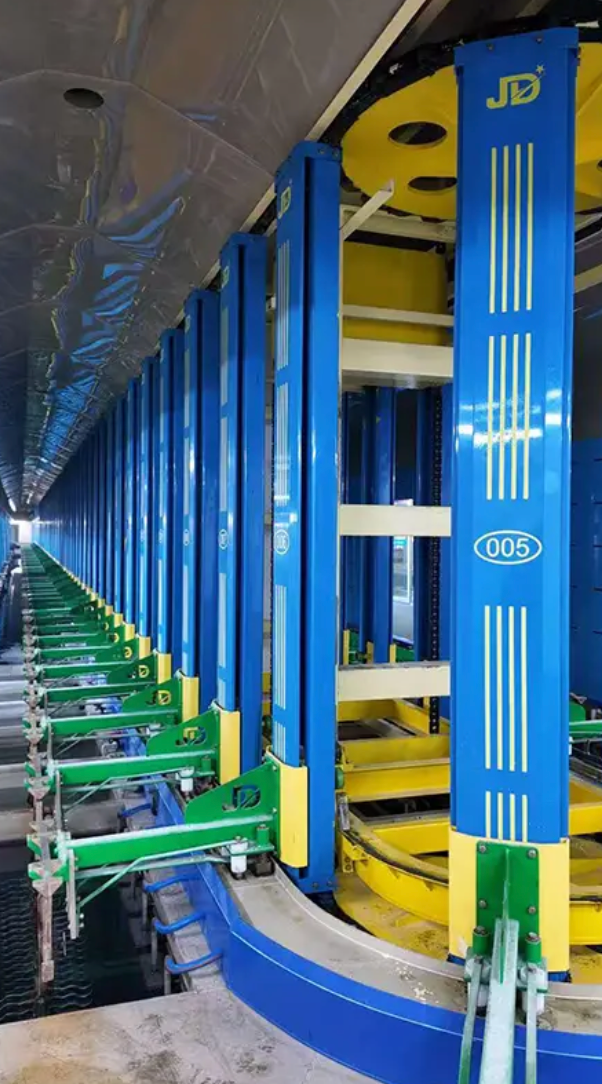
The way a rack presents parts to the anode has a direct hand in how evenly zinc deposits. Small shifts in crossbar spacing or the angle of contact tips can pull more current toward the middle of the rack, which reduces the edge-heavy buildup that shows up as dull, thick patches. Rather than chasing bath chemistry, many lines see fast gains from simply moving lower-current-density parts toward the rack edges and keeping high-density work closer to the center.
Spine and frame dimensions also play a bigger role than they get credit for. A wider spine copper core lowers resistance along the vertical run, so parts hanging near the bottom don't starve for current while the top row gets a heavy plate. Adding non-conductive shields or adjusting the distance between the outermost parts and the anode can flatten the thickness range across the entire load. It's often a few millimeters of repositioning that brings the standard deviation down more than a longer plating time would.
Contact point design matters too. If hooks or rack tips vary in pressure or surface area, the initial current path is uneven before the zinc even starts to build. Swapping worn contact points and ensuring each part gets the same spring tension makes a measurable difference in final thickness uniformity. These mechanical adjustments are cheap compared to rectifier upgrades, yet they routinely cut thickness variation by a meaningful margin.
Solving the Drag-Out Problem in Zinc Plating Lines
Drag-out rarely behaves as a single variable; it shifts with rack design, barrel perforation, and the way operators time the lift. Work that cups solution or leaves blind holes facing upward will carry far more zinc electrolyte than a properly tilted load. Simply slowing the hoist withdrawal and giving parts an extra fifteen to thirty seconds of drip time over the process tank returns a surprising amount of solution that would otherwise be lost.
A drag-out recovery tank placed directly after the plating cell changes the economics. The first rinse captures the bulk of the concentrated film, and that solution can be pumped back to the plating tank as evaporation make-up. Using a fog spray or air knife above the recovery stage knocks droplets off before they reach running rinses, which keeps the subsequent rinse bath far cleaner.
Bath-side adjustments are just as important. Reducing surface tension with a low-foam wetting agent thins the liquid film and speeds drainage, while keeping the bath at the upper end of its temperature range lowers viscosity. Operators who track drag-out by watching first rinse conductivity can adjust return flow or fresh water input in near real time, which cuts waste treatment load without overcomplicating the line.
How Vertical Motion Affects Plating Bath Circulation
Vertical motion in a plating tank does more than simply move parts up and down—it rearranges the local flow field in ways that directly shape bath circulation. When a workpiece rises, it drags a thin layer of electrolyte along its surface, creating a low-pressure wake behind it. As the part reverses direction, that trailing fluid is pulled inward, forming small vortices that can either refresh the diffusion layer near recessed areas or, if the stroke is too short, leave stagnant pockets untouched. The key is that vertical motion does not uniformly mix the bath; instead, it generates a pulsating, asymmetric pattern that depends on part geometry, stroke length, and speed.
These pulses matter because they change how ions are delivered to the cathode surface. During the upward stroke, fresh solution is drawn from lower regions of the tank, often carrying higher concentrations of metal ions and additives. On the downward stroke, the part pushes solution toward the tank floor, creating a return flow along the sides. Over many cycles, this sets up a slow toroidal circulation—up through the center of the tank, down along the walls—but only if the vertical amplitude is large enough to couple both regions. Short strokes, by contrast, tend to recirculate the same depleted boundary layer, leading to non-uniform plating thickness even though the part is moving.
Practical adjustments often focus on breaking that symmetry deliberately. Adding a pause at the top or bottom of the stroke lets the bath relax and reduces the formation of persistent vortices. Varying the stroke length between cycles can also prevent the buildup of stagnant zones behind flanges or deep cavities. In barrel plating, vertical oscillation of the barrel itself produces a sloshing effect inside the load, forcing solution through the perforations and improving coverage on parts buried in the center. Ultimately, the goal is not simply more agitation, but a vertical motion pattern that continuously exposes the surface to solution of consistent composition.
Designing Plating Racks for Mixed-Volume Finishing Jobs
Mixed-volume racks fail when they treat every hook position the same. A rack holding both tiny pins and large housings has to balance current density from the start. I usually place high-mass parts on the outer edges or pair them with non-conductive shields so they don't steal current from smaller components sitting closer to the center. Titanium-clad copper spines with moving crossbars let operators relocate contact points between batches, which cuts rebuild time dramatically.
Solution drag-out becomes a bigger problem when the rack carries parts of very different sizes. Dense rows of small parts trap liquid in recesses and around contact tips, so adding angled brackets or drip breaks along the spine helps drainage before the rack leaves the tank. For mixed runs, split-level racks with removable satellite bars work well—small parts clip onto the top rails while heavier castings hang from the lower hooks, letting one section be swapped without shutting down the entire line.
The Maintenance Rituals That Keep Vertical Lift Lines Running
Long before the first skier clips into a chair, the maintenance crew is already moving along the haul rope with headlamps and torque wrenches. They listen for the faint tick of a worn sheave bearing and run bare hands over grip jaws to catch hairline cracks no one else would notice. On cold mornings, the bullwheel’s brake tests get logged twice—once after the overnight freeze and again once the sun hits the steel—because temperature swings can hide a sluggish caliper until it’s too late.
Weekly rituals are less about fixing and more about proving the lift is still honest. Every grip gets a measured squeeze, every tower’s comm line gets a tug-test, and the rope’s diameter is checked at a dozen fixed points with a micrometer that lives in a battered leather pouch. Hydraulic tension readings are written in pencil on a clipboard that has seen a decade of seasons, and any number outside the margin means the lift doesn’t spin until the cause is found—no shortcuts, no “probably fine.”
When the snow melts and the crowds vanish, the real deep maintenance begins. Grip assemblies come off the line and get stripped to bare metal, welds are inspected under black light, and worn chair pivot bushings are replaced before they can squeak into a failure. Test runs happen with sandbags and water barrels riding the chairs, and only after a state inspector signs off on a full-load brake stop does the lift earn its next winter.
FAQ
Vertical lift rack systems keep parts fixed on racks that move up and down through each process tank, unlike barrel plating where parts tumble together. This prevents surface damage and provides a much more uniform zinc layer, especially for parts with deep recesses or sharp edges. The vertical transfer also minimizes drag-out between tanks, so rinse water stays cleaner longer.
The lift design replaces long chains or belts that are often exposed to acidic fumes and splashing. Sealed lift columns and corrosion-resistant guide rails mean fewer moving parts in contact with chemicals, which reduces breakdowns. As a result, the line can run longer between scheduled maintenance shutdowns.
It works particularly well for medium to large steel or iron parts that need a dependable zinc coating, such as automotive brackets, fasteners, stampings, and tubular components. Because the parts are hung vertically and held stationary, even complex shapes with blind holes get better coverage than in a rotating barrel.
A standard line includes loading, alkaline cleaning, rinsing, acid pickling, rinsing, zinc electroplating, rinsing, passivation or chromate conversion, final rinsing, and drying. The vertical lift carriage transfers the entire rack from one station to the next without tipping, which cuts down on bath contamination and drips.
Inspect the lift tracks and load hooks weekly for wear or zinc buildup, and wipe down any areas where solution mist collects. Verify limit switches and emergency stops before each shift, and keep plating bath parameters like temperature, pH, and brightener levels within a narrow range. Replacing filters and passivation chemicals on a fixed schedule prevents most quality drift.
Yes, the line can be scaled by changing the number of process stations, rack size, and travel stroke. Small shops might use a semi-automatic cell with manual controls, while high-volume plants can opt for full PLC automation with recipe storage and barcode tracking. Modular tank construction also allows adding new stages later without reworking the whole line.
Overloading racks beyond the rated current density leads to thin or burnt deposits on inner surfaces. Zinc buildup on rack contacts should be stripped regularly to avoid poor electrical connection. Also, make sure drip time between stations is long enough to prevent cross-contamination, and watch for rectifier ripple that can cause rough or hazy zinc.
Conclusion
Vertical lift rack zinc plating equipment shifts the equation for shops that handle fragile or high-mix parts. Where barrel plating can bruise threads, fine edges, or stamped details, the stationary racking and controlled vertical lift keep delicate components from colliding, so surface quality holds up across runs. Small adjustments to rack geometry—spacing parts a bit further apart near high-current zones, or using auxiliary thieves on long runs—make a real difference in zinc thickness uniformity, cutting the over-plating and thin spots that often show up on barrel work. The drag-out issue is also less stubborn: pulling racks straight up with a steady speed lets more solution drain back into the tank before rinsing, which reduces chemical waste and keeps the line cleaner.
Vertical motion does more than drain parts; it stirs the bath in a predictable way. A smooth lift and lower cycle creates a gentle push-pull through the rack envelope, helping fresh zinc solution reach recessed areas without aggressive air agitation that can disturb fragile loads. Racks built for mixed-volume finishing jobs—say a few large brackets alongside dozens of small fasteners—benefit from modular crossbars and adjustable contact points, so one line can handle varied orders without constant re-racking. Underneath it all, the maintenance rituals matter: checking anode connections, scrubbing contacts, and realigning lift guides every week keeps vertical lift lines from drifting into uneven plating or mechanical snags. It is the sum of these small, deliberate habits that makes the equipment reliable for metal finishing day after day.
Contact Us
Contact Person: hayyr
Email: [email protected]
Tel/WhatsApp: 8613082110525
Website: https://www.jundaelectroplating.com