

Wholesale Healthcare Wristband Kiosk Terminals: The Smart Way to Enhance Patient Identification
2026-07-01
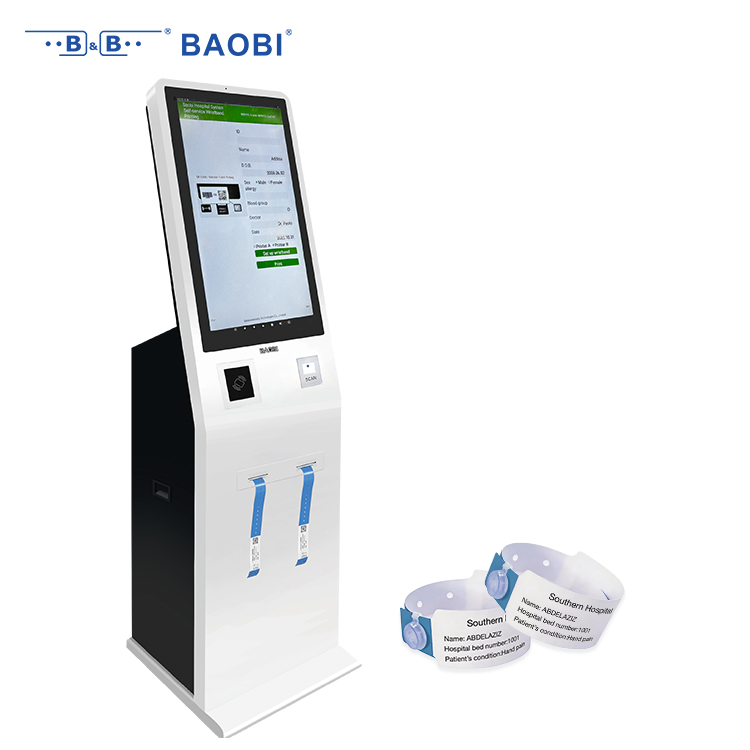
Patient misidentification remains a hidden threat in healthcare, causing everything from delayed treatments to dangerous medication errors. But what if the check-in process could instantly, accurately, and hygienically generate error-proof ID wristbands? BAOBI wholesale healthcare wristband kiosk terminals make that vision a reality. By bringing on-demand, EHR-synced printing directly to patients, they slash identification risks while streamlining workflow. Ready to see how this smart tech is reshaping patient safety—and your bottom line? Let’s dive in.
Streamlining Patient Check-In with Self-Service Kiosks
The sight of a crowded waiting room with a long queue at the reception desk is becoming a thing of the past thanks to self-service check-in kiosks. These touch-screen stations empower patients to verify their details, sign consent forms, and update insurance information independently, cutting down the typical in-person registration time from ten minutes to under two. By shifting routine administrative tasks away from front-desk staff, clinics can redeploy their team to handle more complex queries, resulting in a smoother flow of patients and less congestion during peak hours.
Beyond speed, the kiosks introduce a welcome layer of consistency to data collection. Patients are prompted to confirm their contact information, medication lists, and allergy status at every visit, reducing the risk of outdated records that can lead to billing errors or clinical oversights. The system can also flag missing fields or required updates in real time, something a hurried manual check-in might overlook. For repeat visitors, the process becomes even faster as the kiosk recalls their preferences and pre-fills most fields, leaving them with only a quick review and a tap to complete.
Facilities that have integrated these kiosks report both higher patient satisfaction scores and a noticeable drop in no-show rates. The self-directed experience respects the individual's time and privacy, allowing them to skip the public disclosure of sensitive information at a counter. Many kiosks also offer multilingual interfaces and large-print options, ensuring the technology is accessible to a diverse patient base. When linked with real-time scheduling, the system can instantly alert clinical staff that a patient has arrived, further trimming idle time and keeping appointments running on schedule.
Boosting Accuracy in Identification and Data Capture
Modern systems rely on layered verification methods that go far beyond simple barcode scans. By combining optical character recognition with machine learning classifiers, even damaged or partially obscured labels can be decoded with remarkable precision. This approach cuts down on manual rechecks and keeps inventory flows steady, all while adapting on the fly to new formats or unexpected input.
The real edge comes from continuous feedback loops built directly into the capture pipeline. When a read fails or falls below a confidence threshold, the system logs the anomaly, refines its models, and retrains on the spot—no downtime, no batch processing. Over weeks, this tightens accuracy rates well past what static setups can manage, especially in high-variance environments like logistics hubs or pharmaceutical packaging lines.
On the hardware side, multi-spectral imaging and adaptive lighting strip away the noise that trips up conventional sensors. Instead of relying on a single snapshot, the capture device fires a rapid sequence under different wavelengths, fusing the clearest elements into one sharp output. It’s a quiet revolution in places where every digit matters, from serial numbers etched on metal to codes printed on curved, reflective surfaces.
Enhancing Safety Through Real-Time Wristband Printing
Hospitals are increasingly turning to real-time wristband printing at the point of care to eliminate dangerous identification errors. By generating a wristband immediately after registration or triage, staff ensure that every patient’s information is current and legible, drastically reducing the risk of misidentification during medication administration or blood draws.
The integration of wristband printers with electronic health records means that any change—allergy updates, code status, or room transfers—can be reflected on a new band within seconds. This dynamic linking closes the gap between a patient’s digital record and the physical identifier on their arm, preventing caregivers from relying on outdated or handwritten information.
Beyond accuracy, real-time printing supports infection control and operational efficiency. Wristbands produced on durable, antimicrobial materials can be printed only when needed, eliminating pre-printed stock that might become contaminated or wasted. This just-in-time approach also streamlines workflows, as nurses no longer need to search for or manually fill out wristbands, allowing them to devote more attention to direct patient care.
Reducing Workflow Friction for Clinical Staff
Clinical staff often juggle patient care with administrative tasks that pull them away from what matters most. By simplifying documentation requirements and automating routine data entry, we can remove the small, repetitive obstacles that accumulate throughout a shift. This allows nurses and physicians to redirect their energy toward patient interactions rather than paperwork, resulting in both higher job satisfaction and more attentive care.
Technology should adapt to clinical workflows, not the other way around. Integrating decision support tools directly into electronic health records, for instance, reduces the need to switch between platforms or memorize complex protocols. When alerts are tailored to the patient's specific context and presented at the right moment, clinicians spend less time deciphering irrelevant warnings and more time acting on meaningful insights.
Improving the physical layout of workstations and supply rooms also plays a subtle but powerful role. Simple adjustments—like placing frequently used items within easy reach or redesigning nurse stations to minimize walking distance—can trim accumulated seconds into saved hours over the course of a week. These environmental tweaks, combined with smarter digital systems, create a smoother rhythm for the entire care team.
Improving Patient Experience and Trust
Patients often remember how they were treated long after the specifics of a medical visit fade. Simple gestures like looking someone in the eye, explaining procedures in plain language, and genuinely listening to concerns can turn a clinical encounter into a reassuring one. When care feels personal rather than transactional, anxiety drops and confidence in the provider grows naturally.
Trust also builds when the healthcare journey doesn't become a maze of paperwork and waiting rooms. Clear appointment reminders, transparent billing, and minimal hold times show respect for a patient's life outside the clinic. Small improvements in these operational details signal that the organization values the person, not just the appointment slot.
Follow-through after care is another pillar. A check-in call or message asking how recovery is going reinforces that the relationship extends beyond the exam room. Inviting patients to share feedback—and acting on it—completes the circle, showing that their voice truly shapes the experience.
Scalable Solutions for Modern Healthcare Facilities
Growth in healthcare doesn't follow a straight line—patient volumes surge unpredictably, new wings open overnight, and technology cycles turn over faster than renovation plans can keep up. Facilities that lock themselves into rigid infrastructure find themselves perpetually out of step, either hemorrhaging money on overbuilt capacity or scrambling to retrofit when demand spikes. The alternative is designing with elasticity baked in from day one, so that both physical spaces and operational workflows can flex without forcing a complete overhaul each time the landscape shifts.
True scalability lives at the intersection of modular architecture and adaptive service models. Think of procedure rooms that convert from outpatient to acute care with minimal downtime, or digital health platforms that let you layer in remote monitoring without ripping out existing clinical systems. It's not just about adding square footage—it's about building layers of capability that can be switched on as needs evolve, whether that's a sudden flu outbreak demanding isolation capacity or a long-term pivot toward home-based care delivery.
What often gets overlooked is the human element: scalable solutions have to be workable for staff under pressure, not just elegant on a flowchart. Nurses and physicians need to navigate new configurations intuitively, without halting their routines to decode a designer's clever layout. That means investing as much in modular training and change management as in movable walls or hot-swappable equipment. After all, a facility only becomes resilient when the people inside it can adapt at the same speed as the building itself.
FAQ
They are self-service stations that let hospitals and clinics instantly print durable, custom patient ID wristbands, typically purchased in bulk to cut costs and streamline admission workflows.
By generating accurate, scannable wristbands on the spot, they eliminate manual handwriting errors and ensure every patient gets a verified, legible identification band that links directly to their electronic health records.
Yes, they usually connect seamlessly with EHR and patient registration systems via HL7 or API, pulling demographics and allergy info automatically to print without double data entry.
Wholesale pricing dramatically reduces the per-band cost, and the kiosk's on-demand printing means no wasted pre-printed stock or rush orders, plus fewer misidentification incidents that lead to expensive errors.
Absolutely. They're built for speed and ease of use, allowing staff or even self-registering patients to print a wristband in under 20 seconds, keeping patient flow steady even during peak hours.
They often support multiple languages, various band sizes from neonatal to adult, and can print specialized alerts like fall risk or allergies, making them versatile across every unit, from maternity to geriatrics.
Most vendors offer remote monitoring and proactive supply replenishment under wholesale contracts. The kiosks are designed with minimal moving parts and easy media loading, so on-site IT involvement is rarely needed.
Yes, many models include antimicrobial surfaces and touchless printing options, allowing staff to keep a safe distance and reducing the number of shared touchpoints compared to manual wristband assembly.
Conclusion
Modern healthcare organizations are turning to wholesale wristband kiosk terminals as a practical way to refine patient identification from the moment someone walks through the door. These self-service stations streamline the check-in process by letting patients verify their own details, which cuts down long queues and frees front-desk staff for more complex tasks. As the kiosk captures information directly from official documents or existing records, it virtually eliminates transcription mistakes that often plague manual data entry, making the data capture step far more reliable. When this accurate profile is instantly printed onto a durable, real-time wristband, facilities close the loop on a critical safety concern: the band becomes the single source of truth for medication dosing, lab draws, and procedure matching, drastically reducing the chance of misidentification.
Beyond precise identification, these terminals tackle less visible problems that weigh on daily operations. Clinical teams deal with fewer interruptions because they no longer have to chase down paperwork or re-correct wristband errors, which helps them stay focused on direct care. Patients, in turn, feel more confident when they see their own photograph and correct details printed right in front of them, building trust in the system and a smoother overall experience. The scalable nature of these kiosks means they slip easily into everything from a single outpatient clinic to a sprawling multi-site hospital network, adapting to fluctuating patient volumes without demanding months of specialized training. By weaving together faster check-in, tighter accuracy, constant safety reinforcement, and genuine relief for both staff and patients, wholesale wristband kiosk terminals represent a quietly powerful evolution in how hospitals approach everyday patient identity management.
Contact Us
Contact Person: Bill Xu
Email: [email protected]
Tel/WhatsApp: 8618688898707
Website: https://www.baobitech.com/